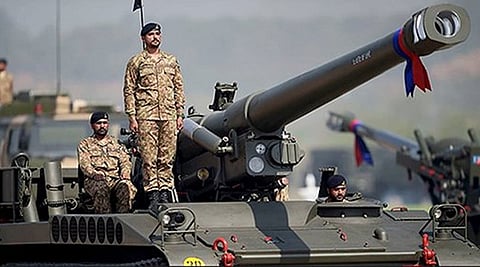


The promise of Pakistan, a nation apparently forged as a democratic homeland for South Asian Muslims, has rarely felt more distant than it does today. Under the stewardship of its current military leadership, the country is undergoing a profound transformation that bears troubling similarities to the most repressive periods of its history, with consequences that threaten to destabilise not just Pakistan, but the entire region.
The Crumbling Facade of Justice
Pakistan's judicial system, long considered a fragile bulwark against executive overreach, has been systematically hollowed out.
The International Commission of Jurists last year documented how military courts have tried civilians with a staggering 100 percent conviction rate, proceedings that fall "well short of national and international standards requiring fair trials before independent and impartial courts". These trials, conducted in secret without meaningful right to appeal, represent what the ICJ calls "a glaring surrender of human rights".
The human cost of this militarised justice system is embodied in former Prime Minister Imran Khan, who has reportedly lost near-complete vision in one eye while incarcerated incommunicado. Despite recommendations from three retina specialists at Al-Shifa International Hospital, Islamabad, prison authorities have denied them access, instead conducting examinations by government-selected doctors.
The contrast between the medical care afforded to the country's most famous political prisoner and the sweeping immunity recently granted to military leadership, including lifetime protection from criminal proceedings for the army chief, Asim Münir, could not be starker.
The Price of Dissent
The crackdown extends far beyond Khan's Pakistan Tehreek-e-Insaf party. In Balochistan, human rights activist Dr Mahrang Baloch was arrested after her organisation, the Baloch Yakjehti Committee, attempted to claim dead bodies of alleged insurgents from a Quetta hospital.
While state media portrays these actions as "aiding terrorists," human rights observers see a deeper pattern: the silencing of voices demanding accountability for the thousands of Baloch youth who have died in custody in recent years.
The Pakistan Army has been targeting the Baloch youth, kidnapping them and later killing them extra-judicially, claiming they were killed in encounters, a shorthand for staged deaths.
The fearless lawyer couple Hadi Ali Chatta and Imaan Mazari now languish in prison following a January conviction that handed them a combined 17-year sentence over social media posts deemed to promote an "anti-state narrative". Their case, currently awaiting a hearing before the Islamabad High Court, exemplifies how cybercrime laws have been weaponised against the legal community itself.
Meanwhile, former parliamentarian Ali Wazir remains incarcerated for raising his voice against military operations in Pashtun regions - arrested, as rights activist Afrasiab Khattak noted, "for raising his voice against the military" while the state shows "soft attitude towards the terrorists".
Wazir's case follows a familiar pattern: flimsy charges, including allegedly using "derogatory words for the founder of the nation," registered to justify the arrest of a vocal critic.
Ali Wazir like other Pashtun Tahaffuz Movement (PTM) leaders have been demanding accountability for the military operations and its day-to-day conduct amid reports of a spike in terror related incidents. Many opposition activists claim the military is supporting the Pakistani Taliban and Al Qaeda militants and providing sanctuary to create a plausible yet perpetual crisis in support of anti-terror operations.
Under the guise of such operations, the military is able to plunder the local natural resources - precious stones - unabated and without any civilian oversight.
The General's Shadow
At the helm of this system stands General Asim Munir, whose consolidation of power has drawn international concern.
The United Nations Human Rights Office recently warned that constitutional amendments rushed through without consultation "seriously undermine judicial independence and raise grave concerns about military accountability and respect for the rule of law".
These changes, which establish a new Federal Constitutional Court with judges appointed on the prime minister's advice, effectively subordinate the judiciary to executive control.
In the past few years, the repression has gone global. Pakistan has developed what rights groups call a system of "transnational repression" targeting journalists, activists, and political opponents abroad.
Under Munir, critics and journalists in the diaspora (here and here) are being targeted even more relentlessly, demonstrating that the military's shadow now follows Pakistani citizens wherever they go.
Yet the General projects an image of vulnerability. Recent photographs showing Munir addressing personnel from behind what appeared to be bulletproof glass (though officially denied by state media) suggest a leadership both omnipresent and deeply fearful, a contradiction that defines Pakistan's current trajectory.
Regional Recklessness Abroad
Pakistan's internal repression finds its external parallel in military adventurism. Defence Minister Khawaja Asif recently warned of "further military strikes on Afghanistan" unless Kabul provides "credible assurances of peace". This aggressive posture, combined with accusations that India is waging a "proxy war" through militant attacks, threatens to ignite regional conflict at a moment when Pakistan can least afford it.
Simultaneously, the government has expressed willingness to contribute troops to Gaza as part of the US-helmed so-called peace force. Asim Münir and his junta continues to position itself as a player in US-Israel strategic calculations regarding Iran.
This alignment with Western powers - even as those same powers grow increasingly concerned about Pakistan's human rights record - represents a dangerous gamble. A US congressional panel has already heard testimony on potential sanctions over Pakistan's repression of dissidents abroad.
The Economic Foundation Crumbles
All of this unfolds against an economic backdrop of staggering fragility. With GDP growth at just 3.2 percent—barely matching population growth—poverty and unemployment are rising inexorably.
Fiscal management under IMF supervision has translated into crushing tax burdens on compliant citizens while development spending plummets. The cost of running the government continues unabated, even as the social fabric frays.
But the elite continue their spending without an iota of shame. Maryam Nawaz, Chief minister of Punjab, is reportedly buying an aeroplane for her use at a staggering cost at a time when crime and suicide are increasingly fueled by the cost-of-living crisis.
Analysts warn that households must focus on "strengthening their own resilience" because meaningful government relief is increasingly unrealistic. This privatisation of survival—families left to cope alone while the state directs its energies toward silencing dissent—captures the tragedy of modern Pakistan.
The Regional Fallout
Pakistan's instability has never been contained within its borders. A nuclear-armed state sliding toward chaos, governed by a military junta increasingly detached from both domestic accountability and international norms, threatens to destabilise the entire South Asian region.
The Tehreek Taliban and Al Qaeda's growing influence, the Baloch insurgency's cross-border dimensions, and the ever-present specter of Indo-Pakistani confrontation—all become more volatile as Islamabad's center fails to hold.
The fruits of this new adventure - the militarisation of justice, the transnational repression, the reckless foreign entanglements - shall create disability in the region for decades. Pakistan, already suffering economic and political meltdown, may find that the chaos it sows abroad returns home many times over.
For the Pakistani people, caught between a crumbling economy and an unaccountable state, the future has rarely looked more uncertain.
Have you liked the news article?
Support us now:
https://www.gofundme.com/manage/jammu-kashmirs-sole-independent-voice-under-threat