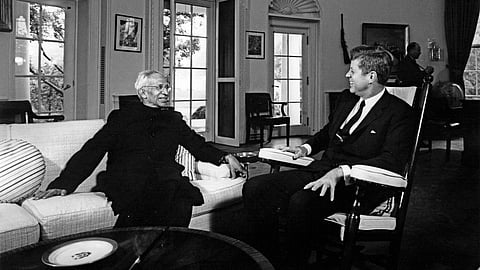


Dr Mohit Sharma & Dr Rashid Ali*
Just two decades back, September 5 remained unquestioned. We accepted its sacrosanctity, turning it into a routine hiatus to honour Dr Sarvepalli Radhakrishnan on his birthday. But we are argumentative Indians: we question everything, much like the old Latin proverb ‘Omnibus dubitandum.’ Internet era made it a lot easier. Suddenly, digital archives of ‘The Modern Review’ from 1929 were right at our fingertips in the form of digital footprints.
Started in 1907, ‘The Modern Review’ soon became an academic journal for Indian nationalists. But in 1929, it also gave voice to a massive controversy. A scholar named Jadunath Sinha published a series of articles accusing Sarvepalli Radhakrishnan of lifting passages straight from his work.
It was a massive allegation, especially against someone viewed as the country's ultimate public intellectual, the man who would eventually become India’s President. To rephrase Albert Camus, ‘plagiarism is a spring in which stolen leaves are passed off as your own blooming flowers.’
Accusation and Counter-allegation
As a promising student of Sarvepalli Radhakrishnan, Jadunath Sinha completed his doctoral research under Radhakrishnan's supervision in 1921 and later published it as a book. Interestingly, when Jadunath Sinha accused Radhakrishnan of plagiarism in the court of Kolkata, Radhakrishnan also accused him of copying the text from Ganganath Jha’s book- Yoga Darsana (1907).
While both were great scholars in their own way, the accusation pertains to the translation - from Sanskrit to English. Both authors copied the same vocabulary. This subtlety of translation can be revealing if we compare the specific passages which Sinha published in The Modern Review. The January 1929 issue of the Modern Review reportedly contained 40 comparative instances, followed by approximately 70 additional instances in subsequent correspondence.
Sinha wrote, “The self can know itself only through its reflection in the mind modified into the form of the object.” Radhakrishnan just changed the self with Purusha: “The puruṣha can know itself only through its reflection in the buddhi, modified into the form of the object.” Where Sinha writes ‘mind,’ Radhakrishnan transposes in buddhi. Another example lies in Sinha’s translation of an indefinable concept - ‘pure intelligence’ as Sanskrit ‘buddhisattva.’ Radhakrishnan translated it as ‘the sattva nature of buddhi.’
Sinha eventually took the matter to the Calcutta High Court, but the dispute was buried in a quiet compromise in 1933, and the nitty-gritties of the settlement were never made public. Eventually, Radhakrishnan became India’s ultimate philosopher-king. Sinha, on the other hand, was reduced to an academic footnote. Because the case was never truly resolved, the controversy just faded away from public view.
Lost in Translation or More?
But if we compare their distinct languages, we may be able to surmise as to what would have transpired. Both scholars wrote Indian philosophy in English via their different linguistic worlds. For Sinha, that mix was Bengali, Sanskrit and English. Radhakrishnan, on the other hand, was working between Telugu, Sanskrit and English.
One could argue that relying on the same Sanskrit sources might give them a similar vocabulary, but what about identical sentence structures, shared oddities, matching thought flows, or the same metaphors? When all those elements line up perfectly, the excuse of just ‘sharing a source’ falls apart. This deep linguistic fingerprint is exactly why Sinha’s evidence deserves a closer look.
In January 1929, Sinha rendered both the texts side-by-side in The Modern Review from his own dissertation and from the passages from Radhakrishnan’s Indian Philosophy. This comparison essentially turned the text into a linguistic laboratory. For instance, Sinha quoted his own line: ‘attention is entirely withdrawn from the mental function in which the self is reflected.’ Radhakrishnan had printed those exact words. That single distinction is the smoking gun in Sinha’s evidence. Secondly, Radhakrishnan published his work six years after Sinha’s dissertation.
Interestingly, when this rumpus made headlines again in our times, it created two distinct groups. The hardline nationalist group swore by Radhakrishnan and swore at Jadunath Sinha, while the moderate nationalist group employed the language of a detective. It put Radhakrishnan and Jadunath both under scrutiny.
Moreover, the rivalry between Radhakrishnan and Sinha goes beyond the question of plagiarism. It also asks a question about an entire generation of Indian intellectuals who translated ancient traditions into the vocabulary of colonial universities, creating what became ‘Modern Indian Philosophy.’
Plagiarism in an AI-world
While the old Sinha-Radhakrishnan plagiarism controversy still pops up today, the actual concept of copying seems to have become completely normalised. Most Indian universities have basically thrown the doors wide open for AI-generated content. Both students and professors lean heavily on AI tools, passing off generated text as their own wisdom.
There is a growing, unspoken pressure that if you don't use these tools, your research looks redundant. It shows in the numbers too. India's research retraction rates have absolutely skyrocketed. While this irks many academicians, it raises a tough question: who actually has the original words left to say without just repeating the past?
(*Dr Rashid Ali and Dr Mohit Sharma teach at Central University of Jammu.)
Have you liked the news article?
Support us now:
https://www.gofundme.com/manage/jammu-kashmirs-sole-independent-voice-under-threat