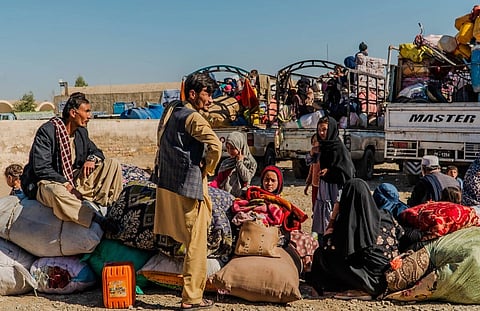


In the closing days of February 2026, Pakistan plunged into what its own defence minister, Khawaja Asif, described as "open war" with neighbouring Afghanistan. Yet on the streets of Pakistani cities, the battlefield has taken a sinisterly different shape — not against the alleged militant combatants, but the poor Afghan refugee families, including women and children born on Pakistani soil, who now face a coordinated campaign of state-backed harassment, ethnic slurs, and mass arrests designed to scapegoat a vulnerable population for the military's own strategic failures.
The Anatomy of a Crackdown
As Pakistani warplanes bombed targets, mainly civilians, in Kabul, Kandahar, and Paktia provinces on February 26, police forces inside Pakistan launched simultaneous late-night raids across multiple cities. In Peshawar, Quetta, Rawalpindi, Islamabad, and Karachi, Afghan nationals were dragged from their rented homes, shops were ransacked, and families were separated as detentions proceeded without due process.
The Khyber Pakhtunkhwa police intensified operations particularly in Peshawar, where sources describe raids becoming "routine". Social media circulates instructions allegedly given to police stations assigning daily targets for detentions — a bureaucratic approach to ethnic cleansing that reduces human beings to quotas. Afghan community members report that fear has confined families to their homes, with adults and teenagers detained while women have also been taken into custody.
What makes this crackdown distinct from previous repatriation efforts is its summary nature. Families with decades of residence in Pakistan, including those holding valid documentation, report being arrested without opportunity to contact relatives or arrange basic necessities.
One Afghan man's lament encapsulates the tragedy: "My only crime is that I'm Afghan. I had papers and they ripped them up". All this brutality and inhuman behaviour is displayed in the month of Ramadan, the month of supposed mercy. That the Pakistani authorities seem oblivious to, or worse, totally insensitive to the holy month has become glaringly obvious.
State-Sanctioned Hate
The campaign against Afghan refugees has not been limited to police actions. It has been accompanied by a coordinated propaganda offensive reaching the highest levels of government. Pakistan's Information Minister Attaullah Tarar has personally championed content that mocks and demeans Afghans, sharing videos through official ministry channels that have gone viral on social media.
One particularly offensive video shows Punjabi students from the top-ranked Lahore University of Management Sciences (LUMS) openly taunting Afghans with the slur "Tandoor wallahs"—referring to the traditional clay ovens used for baking bread—implying that Afghans are fit only for menial labour and not for warfare. The students are heard chanting: "You will attack Pakistan? Oh really? Hey, you even have an air force? Oh really? Apart from running a tandoor, do you also fight wars?"
The video, shared by Tarar's official handles, represents official government endorsement of ethnic ridicule at a moment of active military confrontation. Another widely circulated video features a Punjabi journalist stopping a horse-drawn cart carrying Afghan families who were born in Pakistan. His language is patronising and belittling, treating people with four decades of family history in the country as disposable aliens.
Perhaps most disturbing are videos emerging from Peshawar showing police beating Afghan women and throwing them into vehicles—images of state violence against refugee women that would trigger international outrage if directed at almost any other nationality. These are not spontaneous acts but part of a systematic campaign.
Indian-American journalist Sadanand Dhume described the approach as the "height of stupidity," noting that Pakistan is repeating the same ethnic nationalism tactics it used against Bengalis in the 1970s—tactics that led to the bloody separation of Bangladesh. "The Pashtuns are a powerful minority with significant representation in the (Punjabi-dominated) Pakistani army," Dhume warned. "Not even the worst enemy of the Pashtuns can deny their fighting prowess".
Such a toxic campaign of propaganda and hate unintentionally displays how the majoritarian Punjabis see others within their country and in the neighbourhood. What is really ridiculous is that Punjab has mainly been famous for producing soldiers who have fought for the highest bidder throughout history. For years, Pakistani state-funded propaganda showed Afghans are the best fighters and soldiers of Islam, who had never cozied up to alien rule and have fought at a greater cost, but always ousted foreigners.
Now Pakistan, like everything else in its short but eventful history, has changed its rhetoric to a position that is diametrically opposite to its four-decade-long refrain about Afghans being the best and bravest fighters.
The content is so cringe and so blatantly silly that even Pakistani citizens were forced to condemn. One responded to Tarar's post directly: "This is a racist and insensitive video, there is no humour in it. Seriously, is this the level of your content during wartime? It's disgusting and cheap content".
War Beyond Borders
While refugees face harassment inside Pakistan, Pakistan's military has launched its most aggressive bombing campaign against Afghanistan in years. On February 26, Pakistani airstrikes hit multiple locations including Kabul, Kandahar, and Paktia provinces. The strikes, part of an operation codenamed "Ghazab-lil-Haq" (Wrath of the Truth), were launched after what Pakistan described as Afghan Taliban attacks on its border posts.
The human toll has been devastating. The United Nations Assistance Mission in Afghanistan (UNAMA) reported that at least 42 civilians, including women and children, were killed and 104 wounded during five days of fighting. Approximately 16,000 families have been displaced, and humanitarian facilities, including an emergency hospital and the Torkham transit centre, have been damaged. The World Food Programme has suspended operations in affected areas for safety reasons.
Pakistan's Information Minister Attaullah Tarar claimed that "Afghan Taliban defence targets" were hit, while claiming 72 Afghan militants killed. But Afghan officials reported civilian casualties near the Torkham crossing, with one official stating: "A mortar shell has hit the camp and, unfortunately, seven of our refugees have been wounded, and the condition of one woman is serious".
Pakistan rejected the UNAMA report, claiming it relied on figures provided by the Taliban. But the pattern of civilian deaths follows previous Pakistani strikes. Earlier in February, UN officials said Pakistani strikes killed at least 13 civilians.
The ISI's Digital Warfare
Social media has become a battleground where the Pakistani military's propaganda arm, allegedly including Inter-Services Intelligence (ISI) operatives, actively mocks Afghan casualties and justifies civilian deaths. Accounts believed to be operated by state-linked actors circulate content celebrating the bombing campaign while demeaning Afghan identity.
This digital warfare serves multiple purposes: it manufactures domestic consent for the military campaign, dehumanizes Afghans to reduce sympathy for refugee suffering, and creates an information environment where civilian casualties can be dismissed as propaganda.
The propaganda machine operates alongside actual transnational repression. A recent report detailed how Pakistan's military-backed government has extended its reach abroad, targeting dissidents in Western countries with surveillance, intimidation, and even physical attacks. The same apparatus that hunts Pakistani critics in London and Washington now targets Afghan refugees within Pakistan's borders.
The Diversion Theory: Why Now?
The timing and intensity of both the refugee crackdown and the Afghan bombing campaign suggest a calculated political strategy. Since the imprisonment of former Prime Minister Imran Khan — himself of Pashtun ethnicity — Pakistan has faced growing internal dissent. The military's popularity has plummeted, with anger simmering over Khan's treatment and the perception of army overreach in civilian affairs.
Against this backdrop, external conflict serves as the classic authoritarian pressure valve. By manufacturing an "open war" with Afghanistan and framing Afghan refugees as a fifth column, the military establishment seeks to unite the population around national identity and martial fervour. The refugee community — politically powerless, lacking voting rights, and unable to effectively advocate for themselves — provides the perfect target.
As Dhume noted, "Against this backdrop, a wise Pakistani government would bend over backward not to turn a spat with the Taliban in Kabul into an attack on a domestic minority already smarting over the mistreatment of Imran Khan." Instead, Pakistan is repeating its historic error: "not only repeating the mistake it made in the 70s but also amplifying it multifold with ministers sharing a cringeworthy video filled with ethnic stereotypes".
The Scale of Displacement
The numbers tell a story of staggering human displacement. Over 531,700 Afghans were deported or forcibly returned in 2025 alone, with Human Rights Watch documenting the use of "violence, intimidation, and coercion". Approximately 1.6 million undocumented Afghans remain targeted for expulsion. Even those with Afghan Citizen Cards — some 800,000 people — had their permits cancelled in April 2025. The 1.3 million UNHCR-registered refugees have temporary permission only until June 30, 2026, after which their fate remains uncertain.
Compounding the tragedy, more than 44,000 Afghans approved for resettlement to Western nations, including the United States, Canada, and the United Kingdom, remain trapped in Pakistan, unable to leave and facing the same harassment as undocumented refugees. These are people who have already passed security vetting for Western admission, yet they are swept up in the same dragnets.
International Condemnation and Regional Fallout
The international community has raised alarm. The International Organization for Migration warned of the "growing humanitarian impact" and the strain on Afghanistan's limited capacity to absorb millions of returnees. The UN special rapporteur noted that returning to Afghanistan puts many at "real risk of violent retaliatory attacks".
As the situation deteriorates, Turkey's President Recep Tayyip Erdogan has called for a ceasefire, though he notably did not condemn Pakistan's attacks. Saudi Arabia intervened earlier in February to mediate the release of three Pakistani soldiers captured by Afghanistan, underscoring regional concern over escalating conflict.
The United Nations Assistance Mission in Afghanistan documented the civilian toll with specificity: at least 42 civilians killed, 104 wounded, and 16,000 families displaced. These are not combatants caught in crossfire. They are farmers, shopkeepers, and children whose homes happened to be near Pakistani bomb sights.
A Dangerous Path
The convergence of military escalation, state-backed ethnic propaganda, and mass refugee expulsion represents one of the most dangerous moments in recent Pakistan-Afghanistan relations. By treating four decades of refugee presence as a security problem to be solved through force, Pakistan is creating generations of bitterness among Pashtuns on both sides of the border.
The "Tandoor wallahs" video shared by Minister Tarar will not be forgotten by those it mocks. The police beating Afghan women in Peshawar creates memories that outlast any ceasefire. The children of deported families will grow up knowing Pakistan as the place that rejected them —not through impersonal policy, but through the jeers of students, the sneers of journalists, and the batons of police.
Pakistan's military faces a choice. It can continue down the path of ethnic nationalism, manufacturing enemies abroad to distract from failures at home, or it can recognise that the Pashtuns it now mocks include thousands who have served in its own armed forces, contributed to its economy, and enriched its culture. The "open war" declared by the defence minister may be against the Taliban in Kabul, but the war being waged on the streets of Pakistani cities is against humanity itself.
As one social media user responded to Tarar's video: "OMFG, this is so cringe. Straight out of 2015". The tragedy is that Pakistan's approach to refugees belongs to an even earlier era — one defined by the ethnic hatreds that partitioned the subcontinent and continues to haunt it. In 2026, the world expects better. Pakistan's Afghan refugees certainly deserve better.
Have you liked the news article?
Support us now:
https://www.gofundme.com/manage/jammu-kashmirs-sole-independent-voice-under-threat