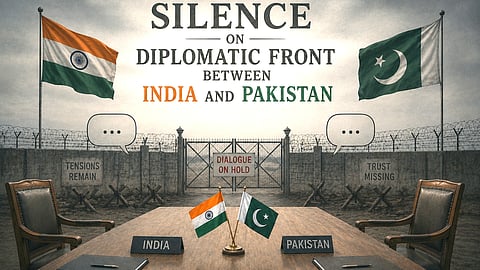


The enduring silence between India and Pakistan has often resembled a hardened wall of distrust - constructed through wars, reinforced by political narratives, and sustained by unresolved grievances. Yet strategists repeatedly demonstrate that even the extreme hardline softens cracks from within. The essential question today is not whether dialogue between the two nuclear neighbours is necessary; rather, it is who will “bell the cat” and take the politically difficult first step toward breaking the stony silence.
Recent discussions emerging from sections of the Rashtriya Swayamsevak Sangh, India’s ideological powerhouse associated with Hindu nationalism, have generated cautious optimism among strategic observers. For decades, it remained a common perception among Indian intelligentsia that meaningful political openings toward Pakistan would only emerge from the hyper-nationalist circles themselves. The reasoning was simple: political actors who cultivate nationalist rhetoric possess greater domestic legitimacy to soften positions without immediately being labelled weak. If hostility was intensified by hardliners, perhaps reconciliation too may begin from within those same circles.
Whether such statements are part of a broader political design remains uncertain. In diplomacy, however, intent is often secondary to action. As scholars of international politics remind us, political outcomes are shaped less by rhetoric and more by sustained behavioural shifts. The challenge, therefore, lies not in decoding hidden intentions but in identifying whether a meaningful diplomatic window has begun to emerge.
The Kashmir Question
Since the constitutional changes of August 2019, when India revoked the special status of Jammu and Kashmir through the abrogation of Articles 370 and 35A, relations between India and Pakistan entered one of their coldest phases. While for India the move represented greater integration, for Pakistan it was, the move represented a decisive departure from bilateralism to unilateralism, deepening what may be termed a “mega trust deficit.” India’s bifurcation of the region into Union Territories, alongside the revocation, further intensified regional anxieties and its recurrence and repercussions have been observed till date.
From a political communication perspective, the success of the ruling dispensation in India can partly be explained through the lens of the Agenda Setting module of Maxwell McCombs and Donald Shaw, who argued that media may not dictate what citizens think, but profoundly shapes “what they think about”. The extensive investment in nationalist media narratives enabled the political leadership to cultivate public jubilation around Kashmir, framing the constitutional move as a historic triumph and consolidating electoral legitimacy.
Yet triumphalist narratives often obscure deeper structural realities. Data demonstrates that every major peace cycle between India and Pakistan eventually collapsed around the unresolved question of Kashmir. The period from 1947 to 1965 witnessed relative engagement before conflict erupted. The post-Tashkent Declaration phase saw hopes of normalisation, only for mistrust to deepen amid the 1971 crisis and the creation of Bangladesh. The post-Simla Agreement optimism similarly deteriorated, while the occupation of Siachen in 1984 widened the strategic divide.
The late 1980s represented another missed opportunity. Had the people of Jammu and Kashmir been provided greater political space following the disputed 1987 elections, the trajectory may perhaps have unfolded differently. Instead, an extended cycle of armed struggle, militarisation, displacement, and human suffering engulfed the region, consuming immense human and material resources, deepening the trust deficit as India blames Pakistan for promoting insurgency across the borders.
One of the most promising moments emerged under Atal Bihari Vajpayee and Pervez Musharraf. Vajpayee’s vision of Insaniyat (humanity), Jamhooriyat (democracy), and Kashmiriyat offered a moral and political vocabulary for reconciliation. Combined with Musharraf’s diplomatic flexibility, a viable pathway toward conflict transformation appeared possible. Yet hawkish elements derailed the momentum, leaving behind another chapter of unrealised peace.
Lessons from History
History offers lessons. As strategic scholars frequently observe, conflicts produce either gains, losses, or learning. If we learned from repeated failures, then there remains hope for a new diplomatic grammar. Vajpayee famously remarked that while friends may change, neighbours cannot. Geography ultimately imposes realism upon politics.
Ironically, both India and Pakistan share overlapping historical experiences of alliance politics. During the Cold War, Pakistan allied with Western security arrangements such as CENTO and SEATO, while India cultivated strategic partnerships with USSR despite being part of the Non-Aligned Movement. Today, India enjoys close relations with the United States, yet strategic realities continue to evolve in a changing Asian order. The lesson is unmistakable: external alignments cannot substitute for regional peace.
Equally important is the altered balance of power in South Asia. While India has long been recognised as a big regional actor, Pakistan has also demonstrated enduring strategic resilience, emerging as a consequential middle power with substantial military and diplomatic capacity. Yet there is an absolute gap in parity.
Under conditions of nuclear deterrence, war is no longer a viable policy instrument. The logic of Mutually Assured Destruction reminds us that escalation between nuclear states risks catastrophic consequences for both.
RSS’s Peace Talk
This is why the recent signals emerging from nationalist circles in India should be taken positively. Even a small opening deserves cautious engagement. Peacebuilding scholar Johan Galtung distinguished between negative peace, the mere absence of war, and positive peace, rooted in trust, dialogue, and structural reconciliation. The region has experienced prolonged phases of negative peace, what remains absent is positive peace.
The path forward requires incremental Confidence Building Measures (CBMs): restoration of diplomatic engagement, easing visa restrictions, revival of trade, military hotlines, Track-II diplomacy, academic exchanges, and sustained dialogue on humanitarian concerns. The past experiences of peace-oriented forums and conciliation-oriented Track-II platforms between India and Pakistan demonstrate that even deeply entrenched adversaries can slowly rebuild trust when communication channels remain open.
Ultimately, peace is woven through threads, not grand gestures. A single thread may appear weak, yet when nurtured patiently, it can weave a larger fabric capable of transforming hostility into coexistence. South Asia stands at a decisive moment. If even the smallest ray of political willingness emerges, it may rupture decades of darkness. The road ahead remains long, but perhaps the first drop has already fallen, and from that drop, a new dawn may be imagined and the foundational ground for Confidence Building Measures can be prepared.
(The photo has been updated)
Have you liked the news article?
Support us now:
https://www.gofundme.com/manage/jammu-kashmirs-sole-independent-voice-under-threat