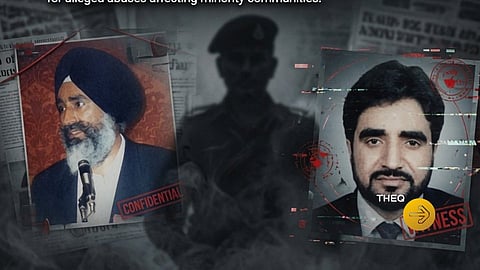


The recent controversy surrounding Satluj, a film inspired by the life and work of Punjab's renowned human rights defender Jaswant Singh Khalra, has reopened an old and uncomfortable debate.
Beyond questions of artistic freedom and historical representation lies a larger issue: how societies remember those who dared to expose human rights violations committed during periods of political violence. Khalra's story has once again entered public discourse. Yet, in remembering him, it is impossible to overlook another human rights defender whose fate followed an eerily similar course, but whose name rarely receives comparable attention: Advocate Jalil Andrabi of Kashmir.
Separated by region, religion and profession, Jaswant Singh Khalra and Jalil Andrabi shared a common conviction. Both believed that even in times of armed conflict, the law mattered. Both painstakingly documented allegations of disappearances, custodial torture and extrajudicial killings. Neither carried a weapon. Their tools were documents, court petitions, witness testimonies and an unwavering faith that truth, however delayed, could eventually prevail.
Instead, both became victims of the violence they sought to expose.
Their stories are not merely biographies of two courageous individuals. Together, they illuminate the human cost of documenting abuses in conflict zones and raise enduring questions about accountability, justice and the limits of democratic institutions when confronted with national security narratives.
Punjab in the early 1990s was emerging from a brutal decade of militancy and counter-insurgency. Thousands of young Sikh men had disappeared after being taken into custody. Families searched endlessly for sons, brothers and husbands who never returned. Many deaths were never officially acknowledged. Bodies were routinely cremated as "unidentified", leaving little trace for relatives seeking answers.
It was Jaswant Singh Khalra, a Bank of India employee in Amritsar, who began connecting scattered pieces of evidence. Through painstaking visits to cremation grounds, examination of municipal records and conversations with crematorium workers, he documented at least 2,097 illegal cremations in Amritsar district alone. Based on available evidence, he estimated that similar practices across Punjab could involve tens of thousands of victims.
Khalra was not a professional activist. He was an ordinary citizen driven by an extraordinary moral commitment. His work transformed rumours into documentary evidence. He gave names and numbers to people whom official records had effectively erased.
His findings eventually formed the basis of the landmark "cremation grounds" litigation that prompted intervention by India's Supreme Court, leading to investigations by the National Human Rights Commission and the Central Bureau of Investigation.
On September 6, 1995, Punjab Police personnel abducted Khalra from his home in Amritsar. According to court findings, he was illegally detained, tortured and killed. His body was allegedly disposed of in the Harike canal and has never been recovered. Years later, nine police officials were convicted for his abduction and murder, with the Supreme Court ultimately upholding life sentences against the principal accused.
Although those convictions represented a significant legal milestone, they answered only one question: who killed Khalra. The much larger issue that he had exposed, the fate of thousands of disappeared persons, has never been comprehensively addressed.
Similar Tragedy
Only months after Khalra's disappearance, a remarkably similar tragedy unfolded in Kashmir.
By the mid-1990s, Jammu and Kashmir had become one of the world's most heavily militarised regions. Armed insurgency, counter-insurgency operations and emergency laws had fundamentally altered everyday life. Reports of arbitrary detention, enforced disappearance, custodial torture and extrajudicial killings had become widespread.
Among those documenting these allegations was Advocate Jalil Andrabi, a respected lawyer associated with the Jammu and Kashmir High Court Bar Association. Andrabi combined legal advocacy with meticulous human rights documentation. He represented detainees, challenged unlawful detentions, and drew international attention to Kashmir's human rights situation, including before the United Nations Commission on Human Rights in Geneva.
Like Khalra, Andrabi believed documentation itself could become an instrument of justice.
On March 8, 1996, Andrabi was detained near Srinagar. Witnesses identified personnel from the Rashtriya Rifles, allegedly acting under Major Avtar Singh, as responsible for his arrest. He was never produced before a magistrate or court. Nineteen days later, his body was recovered from the Jhelum River.
The post-mortem described injuries consistent with severe torture, including broken ribs, electric shock marks and strangulation.
His killing quickly became one of the most extensively documented human rights cases arising from Kashmir. The Central Bureau of Investigation later filed a chargesheet naming Major Avtar Singh as the principal accused. Courts issued warrants. Interpol notices followed. Yet prosecution never materialised.
Protected by legal and procedural barriers governing prosecution of armed forces personnel, Singh left India and settled in the United States. In 2012, he died in a murder-suicide in California after killing members of his own family. With his death disappeared the last realistic prospect of a criminal trial in Andrabi's case.
These two cases reveal more than personal tragedy. They expose contrasting patterns of accountability within India's justice system.
In Khalra's case, despite years of delay, investigators gathered sufficient evidence to prosecute police officers directly involved in his abduction and killing. The convictions demonstrated that accountability, though difficult, remained possible under ordinary criminal law.
Incomplete Investigation
In Andrabi's case, however, the prosecution encountered institutional obstacles from the outset. Requirements for prior government sanction under laws governing operations in disturbed areas effectively insulated the principal accused from civilian prosecution. The investigation remained incomplete, the trial never began, and the family was denied judicial closure.
The contrast is significant. It reflects not merely differences between two cases but broader structural questions about legal accountability in conflict situations.
Yet perhaps the most important similarity between Khalra and Andrabi lies elsewhere.
Neither man advocated violence. Neither was convicted of any offence. Neither called for armed resistance. Their only "crime" was insisting that allegations of disappearances, torture and custodial deaths deserved documentation and judicial scrutiny.
Khalra counted the disappeared. Andrabi defended them before courts and international institutions.
Both challenged a culture in which questions about state conduct were often viewed through the prism of national security rather than constitutional accountability.
Their work demonstrated that documenting abuse is itself a powerful act. Records, testimonies, municipal registers, autopsy reports and legal petitions can become instruments capable of confronting official silence. That is precisely why such work often provokes hostility.
The renewed attention generated by Sutlej therefore carries significance beyond one individual or one state. It reminds us that societies emerging from violent conflicts cannot build lasting peace by selectively remembering victims. Punjab's disappeared and Kashmir's disappeared belong to the same larger conversation about truth, justice and reconciliation.
Democracies derive legitimacy not from denying uncomfortable chapters of their history but from confronting them honestly. A confident constitutional order does not fear documentation. It encourages scrutiny because accountability strengthens rather than weakens democratic institutions.
Three decades after their deaths, Jaswant Singh Khalra and Jalil Andrabi remain symbols of that principle. One was a bank employee from Punjab. The other was a lawyer from Kashmir. One documented secret cremations. The other documented unlawful detentions and custodial torture. Both believed that facts mattered, evidence mattered, and the rule of law mattered.
Their lives remind us that the defence of human rights often begins not with grand political movements but with ordinary individuals willing to ask difficult questions.
As debates over Sutlej continue, the country would do well to remember not only the man whose life inspired the film but also those whose stories remain largely untold. Memory cannot be selective if justice is to have meaning.
Khalra and Andrabi did not seek death. They sought accountability.
Their legacy endures because they refused to allow the disappeared to disappear from history.
Have you liked the news article?
Support us now:
https://www.gofundme.com/manage/jammu-kashmirs-sole-independent-voice-under-threat