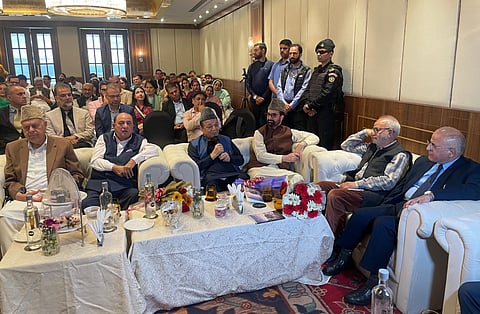


The recently launched book ‘Healer in Exile’, a biography of Dr Sushil Razdan by his son, has generated discussion not merely because of the life it narrates, but because of the title it bears.
Dr Razdan is a respected physician, a dear friend to many, and unquestionably a proud Kashmiri whose service to patients across communities has earned admiration beyond regional and communal boundaries. Any reflection on his work must, therefore, begin with respect, empathy, and recognition of the suffering and displacement experienced by large sections of the Kashmiri Pandit community during the turbulent years of the late twentieth century.
At the same time, any balanced historical reflection must also acknowledge that, alongside Kashmiri Pandit families, a significant number of Muslim families also left the Valley during different phases of turmoil, insecurity, and counter-insurgency. Their departures may not have received equal public articulation or political visibility, yet they formed part of the wider human disruption that scarred Kashmiri society as a whole. Recognizing one suffering should not require the invisibilisation of another.
Yet literature, memory, and history often intersect at a difficult point: the choice of words. Words, especially in a place like Kashmir, are never innocent. They shape perceptions, construct meanings, and sometimes quietly alter political and historical realities.
Weight of ‘Exile’
The debate surrounding the title ‘Healer in Exile’ is therefore not about denying pain. It is about asking whether the language employed conveys that pain with both emotional honesty and conceptual precision.
The term “exile” has a long historical lineage. Traditionally, it denotes banishment from one’s country, expulsion by political authority, or forced existence in a foreign land away from one’s homeland.
Embedded within the word is the idea of rupture - a severing not merely from one’s house or locality, but from one’s nation itself. Dante in medieval Italy, Napoleon on Saint Helena, the Dalai Lama in India, or political dissidents expelled from authoritarian states all belong to this classical understanding of exile.
This is where the Kashmir debate becomes intellectually significant.
Suffering and Displacement
Can movement from Srinagar to Jammu, both within the territorial and constitutional framework of India, accurately be described as “exile” in the strict historical sense? Can residence within one’s own country, however tragic and involuntary, be equated with banishment from it? These are not rhetorical provocations; they are questions of conceptual clarity.
Those who defend the title argue, understandably, that “exile” here reflects an emotional truth rather than a legal or historical category. They emphasize the atmosphere of fear, violence, uncertainty, and loss under which many Kashmiri Pandit families left the Valley. No sensitive observer can deny this trauma. Entire lives were disrupted. Homes were abandoned. Memories were fractured. A generation grew old carrying nostalgia, bitterness, and longing.
Yet emotional truth and historical terminology are not always identical.
A historian’s responsibility lies precisely in distinguishing between the intensity of an experience and the vocabulary used to describe it. Terms such as “forced displacement,” “internal displacement,” or “migration under duress,” retain the gravity of suffering while preserving analytical precision. Simply collapsing all these distinctions into the word “exile” risks stretching language beyond its conceptual boundaries.
Indeed, language matters even more in Kashmir because every word carries political implications. To describe residence in Jammu as “exile” unintentionally suggests that Jammu or India constituted an alien space outside one’s homeland. Such usage subtly reframes Kashmir as a distinct political entity from which one was expelled into another country. Whether intended or not, this vocabulary touches the constitutional and historical sensitivities surrounding accession and identity.
It is equally relevant that Dr Razdan had long maintained a Jammu residence and, like many affluent Kashmiri families across communities, would move there during winters well before the eruption of militancy in the late 1980s. This does not diminish the anxieties and uncertainties that later emerged, but it does complicate the strict notion of a sudden or absolute rupture commonly associated with exile.
This is why precision in language becomes essential.
Words Matter
Words are not merely decorative instruments of storytelling; they are vessels of meaning. A single word can alter the emotional temperature of a narrative. It can heal, accuse, reconcile, divide, dignify, or embitter. The finest writing emerges when language allows readers not merely to understand a story, but to breathe it, to inhabit its sorrow, humanity, and complexity without being pushed toward resentment or ideological rigidity.
Everyday usage itself demonstrates how subtle changes in wording alter meaning. In our letters and conversations, people often write, “I am anxiously waiting for your reply,” when what they truly mean is, “I am eagerly waiting for your reply.” The difference may appear minor, yet “anxiously” conveys worry, unease, and apprehension, whereas “eagerly” expresses warmth, anticipation, and affection. One misplaced word shifts the emotional landscape entirely.
The same problem appears in intellectual and historical discourse. Modern ideological terms such as “secularism,” “socialism,” "nationalism" or “nation-state” are frequently imposed upon ancient or medieval societies whose structures emerged from entirely different civilizational contexts. Likewise, medieval expressions such as maleech or concepts like Sulh-i-Kul are often reinterpreted through present-day ideological lenses, stripped from the social, linguistic, and historical environments in which they originally functioned.
Once words are detached from their context and loaded with contemporary assumptions, they cease to illuminate history and begin to distort it.
This is why historians insist upon conceptual discipline. Precision in language is not pedantry; it is intellectual honesty.
An interesting comparative example may also be noted here. Another distinguished Kashmiri Pandit physician, Dr Upendra Kaul, an eminent cardiologist respected across communities, has likewise written about the tragic exodus of Kashmiri Pandits and the pain associated with it. He treated countless Kashmiris without discrimination, both outside Kashmir and, for many years now, continuously within Srinagar and Pulwama itself. Yet neither his professional identity nor his narrative was framed through the vocabulary of “exile.”
The public engagement around his work remained largely within the sphere of medical fraternity, civil society, and shared human experience rather than political symbolism. This comparison is not intended to diminish one doctor or elevate another, but to demonstrate how the choice of words shapes the tone, interpretation, and reception of a narrative.
The book "Healer in Exile" itself has been authored by Dr Razdan’s son, who understandably writes from the perspective of filial admiration, inherited memory, and emotional association. Such portrayals rarely emerge in isolation and are often shaped, directly or indirectly, through familial understanding and approval. This explains the emotional architecture of the narrative, though it does not remove the legitimacy of critically examining the terminology employed within it.
The ‘Healer’s’ Incomplete Separation
The second dimension of the discussion concerns the title’s first half: Healer.
There can be little doubt that Dr Razdan healed countless people and earned the trust of patients across regions and communities. Stories of Kashmiris travelling long distances to consult him testify to his reputation and professional excellence. Yet even here, the title invites reflection.
When an author or a title implicitly elevates an individual into a symbolic moral category such as “healer,” the distinction between collective acknowledgment and self-characterization becomes delicate. Such descriptions often acquire greater dignity when they emerge organically from public memory rather than from self-designation.
However, this observation should not be mistaken for hostility. Critique, when offered respectfully, is not negation. Intellectual engagement does not diminish suffering; it seeks to understand it more honestly.
Interestingly, the continued relationship between Dr Razdan and people in Kashmir complicates the classical idea of exile even further. Patients continue to visit him. Connections endure. Travel between Jammu and the Valley remains possible. Emotional bonds survive political rupture. In a paradoxical way, this continuity speaks not of total severance, but of an enduring social fabric that violence could wound but not entirely destroy.
Perhaps this is the deeper tragedy of Kashmir: not complete estrangement, but incomplete separation - a condition where memories, identities, and affections continue to cross fractured spaces.
The discussion around ‘Healer in Exile’ ultimately reveals something larger than a disagreement over a title. It reveals how Kashmir remains a battleground of memory, language, and meaning. Every community carries its own grief, vocabulary, and interpretation of history. Yet if reconciliation is ever to emerge, it will require a language that is both humane and precise, one that neither erases suffering nor weaponises it.
For language, when used with care, does more than describe history. It shapes how future generations inherit it.
Have you liked the news article?
Support us now:
https://www.gofundme.com/manage/jammu-kashmirs-sole-independent-voice-under-threat