

The river doesn't ask where it wants to go. It neither negotiates with the boulders that attempt to break through its surface nor seeks the approval of the embankments confining it. Driven by the unchanging law of gravity and the unending promise of the sea, it simply moves through soil and stone.
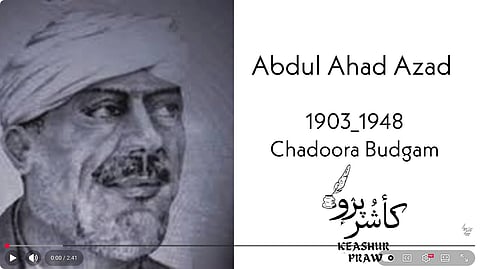
The Kashmiri people have always considered the river to be more than just water; it is a symbol of life, time, and the enduring human spirit. Abdul Ahad Azad, the poet who turned the river into a symbol of revolution and became the voice of a people who were crushed under the weight of the feudal autocracy of Dogra rulers, was the only person who had a better understanding of this.
Abdul Ahad Azad has a place in the pantheon of Kashmiri literature that is both revered and controversial. His verses were a clarion call against autocratic rule, demanding social equality, and giving the voiceless a voice.
His well-known poem Dariyav (The River) became a symbol of unrelenting progress because its waves sang of a world free of the barriers that divide people.
Popularly regarded as the "Revolutionary poet of Kashmir," Azad was a multifaceted personality: a modernist, a historian, a political thinker, a literary critic, and, most importantly, a voice for human conscience.
To comprehend Azad is to comprehend Kashmir's agony under the autocratic tyranny of forced labour, worker exploitation, and the murder of innocent civilians.
However, his legacy also strongly relates to current events, as Iran, the nation whose poetry and philosophy deeply influenced him, is under constant military and geopolitical attack by US and Israeli forces.
The Birth of a Revolutionary
Abdul Ahad Azad was born in 1903 in the Budgam district's Rangar village. His very name, "Abdul Ahad" (Servant of the One), was a testament to the Islamic faith that grounded his early years. He received his education primarily from his father, who instructed him in Persian, Arabic, and Islamic philosophy at a nearby madrassa.
When he was born, Kashmir was groaning under Dogra rule, a dynasty installed by the notorious Treaty of Amritsar (March 16, 1846), which effectively sold the Valley and its people to Maharaja Gulab Singh for 7.5 million Nanakshahee Rupees. Under this regime, Kashmiri Muslims were reduced to near-serfdom, compelled to perform baigaar (unpaid forced labour) while feudal exploitation hollowed out entire communities.
There was a long arc of oppression, waiting to feed resistance. Shawl weavers (shawl bafs) marched against punishing taxes on April 29, 1865, when the Dogra troops killed 28 of them. Silk workers struck in July 21, 1924; at least 10 died. These massacres did not extinguish dissent.
The breaking point came in 1931. The trial of Abdul Qadeer, a butler from Amroha, who publicly denounced Dogra rule, ignited mass protests across Kashmir. On July 13, police fired on unarmed demonstrators, killing 21. The massacre galvanised an entire generation.
Azad, who was one of the many inspired, paid personally for his politics. His home was raided, his family harassed, and he was exiled to a remote posting as an Arabic teacher. While he was away, his four-year-old son died. The loss transformed him. The devotional poet became, in his own reckoning, a skeptic, a rationalist, and an unsparing revolutionary voice.
In the annals of Kashmiri literature, few figures loom as large or as transformational as Abdul Ahad Azad. He was the driving force behind Kashmiri poetry's transition from pure mysticism to the vibrant, gritty reality of modern thought and social revolution, which was overlooked by his classical predecessors. In Kashmiri literature, he is credited with establishing literary criticism.
The Humanism Behind the Fury
Calling Azad an atheist, as some orthodox clerics did, mistakes the nature of his spiritual crisis. His quarrel was never with God — it was with God's gatekeepers: those who wielded religion to sanctify misery and protect power.
His most devastating theological statement was Shikwa-i-Iblis (Complaint of Satan). When the Devil questions divine justice in the poem, Azad is giving voice to every Kashmiri peasant who watched their home flood while the Maharaja's palace stood dry. The orthodox found it so threatening they nearly issued a fatwa declaring him an apostate.
When the orthodox clerics cried blasphemy, Azad's response was a manifesto of liberation:
"O men of faith, you have your own Deen and I have mine.
Your sacred object is God and my ideal is man.
Your God is pleased by building mosques, temples, dharamshalas.
My beloved feels delighted in unity, affection and sympathy."
This was liberation theology before the term existed. He did not reject God; he rejected the those who used God to serve their petty interests. The divine, for Azad, lived in the struggle for human dignity.
His devotional poetry makes this clearer still. Those verses, in contrast to his revolutionary poems, were rooted in traditional love, revealing a soul that never left its faith. He did not abandon religion. He purified it, stripping away the clerical manipulations that had made it an instrument of feudalism.
His Bachae du'a (children’s prayer), as a primary school teacher, is perhaps his most tender expression of faith and carries a profound message for young people and also demonstrates Azad’s core of humanism. Azad imagines the innocent voice of a child speaking to God in this emotional pleading:
"God, protect my father from harm,
Also, God bless my mother for holding me.
Give me some sweet milk and a place to sleep,
And keep all hungry children warm and blessed."
Mehjoor and Azad: Two Poles of Modern Kashmiri Poetry
To understand Azad's unique place in Kashmiri literature, one must view him alongside his contemporary, Ghulam Ahmad Mehjoor.
Mehjoor, the "Wordsworth of Kashmir", wrote of spring blossoms, mountain beauty, and the quiet rhythms of ordinary life. His verse was lyrical, musical, and accessible. Azad was his temperamental opposite. He was intellectual, combative, driven by Marxist and progressive ideas.
Where Mehjoor painted Kashmir, Azad interrogated it, writing about exploitation, religious fanaticism, social inequality, and the suffering of the poor. For Mehjoor, poetry captured beauty. For Azad, it was a weapon for consciousness and justice.
Yet both men, despite their differences, ultimately pointed toward human solidarity across religious divides.
Mehjoor expressed this feeling in a straightforward manner:
"Kashren henz zat butrath chey kuni/
khamukhah doorer mo paeview panewaeni"
(Kashmiris belong to the same caste and have the same land. Don't let trivial matters create wedges between us.)
Azad echoed this thought with profound philosophical depth:
"Qudrats thawni yued asehan beyun beyun milat te qoum/
preth aks beyun beyun zameenah aasmanah Asihay"
(If Almighty had chosen to keep distinct tribes and peoples apart, He would have established distinct skies and lands for each of them.)
A Message to the Youth
Instead of being a distant idol, Azad was a mentor who saw the young people as the only hope. He directs the youth to be the agents of change and progress in his poem Taranai Wattan (Songs of the Country).
He advised them against falling asleep to the soothing songs of the powerful:
"Gulan manz chukh tche trawith lar bichawith makhmaluk bister
Gulan ti gulshanan andar gatchan cha sher-e-nar paida."
("You prefer living in flower beds to expensive furniture, but powerful lions are not raised in flowery gardens")
He saw the youth as the nation's awakening consciousness:
"Yiwan chi az hoshe myani awlad tchetus pewan chukh sitam ti bedad
Akha chu timvei manz yi Azad khodaya haaw tam yihund bahara."
("My boys are gaining conscience and recollect the torture that was subjected to,
One of my boys is Azad; Almighty, bless them with compassion.")
He cautioned youth against succumbing to mortal desires, which he deemed more perilous and destructive than physical chains of slavery:
"Tami khoet chu behtar zovlana ghulami hund.
Yus lol jawn mardan istade pather paway."
("It's better to die than to be controlled by lust.
Come, let us stick together as men in the sand like rocks.)
Azad and Ali Shariati
As a revolutionary intellectual, the closest parallel to his work is Iran's Dr Ali Shariati, ideologue of the 1979 Revolution, who synthesised modern socialism with Shia Islam to build a philosophy of resistance against the Shah.
Azad did something structurally identical, only earlier. He drew on Kashmir's literary traditions and the ethical core of religion to wage war on Dogra monarch’s tyranny.
To grasp the full arc of Azad's vision, the most useful lens is Ibn Khaldun (1332–1406), the North African historian widely regarded as the father of sociology.
His masterwork, the Muqaddimah, advances a cyclical theory of history built around Asabiyya (social cohesion), the binding force of shared purpose. Dynasties rise when a group forged by strong Asabiyya rooted in faith, kinship, or common struggle displaces a decadent ruling elite. But power corrupts solidarity. Comfort replaces toughness, cohesion dissolves, and the dynasty grows vulnerable to a new, more vital force rising from the margins.
The Dogra rulers, bloated on feudal privilege, had long since lost their moral authority. Azad's poetry can be read as a sustained call to rebuild Asabiyya, not along tribal or sectarian lines, but around the shared condition of Kashmir's weavers, workers, and peasants: their oppression, their dignity, their hunger for justice. His verses were the drumbeat of a new solidarity against a dynasty already in decay.
Iran as a Spiritual Homeland
Understanding Azad's ties to Persian culture is essential to comprehending his universalism. His father taught him Persian at a young age, and he also studied the great Persian poets and inherited their "colouring of metaphors and similes," which connected him to a civilisation that extended from Shiraz to Srinagar. As evidence of the deep historical, cultural, and linguistic ties that exist between the two regions, Kashmir has historically been referred to as "Iran-e-Saghir" (Little Iran).
This intertwined heritage is reflected in the poetry of Sir Muhammad Iqbal (Allama Iqbal), who popularized this term in Shikwa and Jawab-e-Shikwa.
Scholars have long emphasized these "cultural and literary links," pointing out that saints spread Islam in Kashmir. Even Mir Sayyid Ali Hamadani, who wrote more than 150 works in Arabic and Persian, was heavily influenced by Iranian literature.
Because of this cultural legacy, anyone who understands Azad can relate deeply to the current tragedy in Iran. If Abdul Ahad Azad were alive today, how would the poet who gave voice to the voiceless respond to this spectacle? If he were, he would have seen that oppression wears the same face across centuries. He would write that true faith demands resistance, and that the revolution never rests.
If Iran's youth, living under sanctions and the shadow of war, could read Azad, they would find a message for them: the revolution is your awakening, not someone else's gift. It would speak of a shared human conscience that can dissolve the man-made borders between them and Gaza.
And The River Flows On!
Azad died on April 4, 1948, in Srinagar, of appendicitis, at the age of 45*. He left behind Kashmiri Zaban aur Shayiri, his three-volume history of Kashmiri language and poetry, and these words on his tombstone:
"The whole world will think of me and scream Azad Azad
Loved one, I will remind you someday."
His memorial in Rangar, Chadoora Budgam reads: “In eternal memory of the Poet of Revolution and pioneering literary historian of Kashmiri language”.
His words are not only relevant in Kashmir but also beyond. The walls he wrote against are still standing — across the globe. In Iran, they are rising higher now, reinforced by sanctions, missiles, and the old game of divide and rule. Families in Tehran bury their dead. The powerful build their temples.
The river, a revolution that was fed by his poetry, can water the parched fields of a world that is desperate for peace. Azad's voice runs in its current, whispering to every worker, every dreamer: Inqalab. Inqalab. Revolution. Bring the revolution.
"I shall not rest till the world is rid,
of the dividing embankments.
Of a deformed ditch and hollow,
It's a lovely, smooth face.
Like a consuming fire, this passion,
even though I'm water, it burns me."
—Dariyav, Abdul Ahad Azad
(*Note: When Azad died in April 1948, as Kashmir became the fault line of a newly partitioned subcontinent, his life's work lay beside him in chaos: a scattered heap of manuscripts his friend and scholar Dr. Padam Nath Ganjoo spent years salvaging, correcting, and organising. The resulting Kulliyat-e-Azad was, in the words of JKAACL's Mohammad Yousuf Taing, a "document of identity" for the Kashmiri language. It records Azad's journey from traditionalist to modernist and his insistence that poetry must not merely praise beauty but diagnose society.)
Have you liked the news article?
Support us now:
https://www.gofundme.com/manage/jammu-kashmirs-sole-independent-voice-under-threat