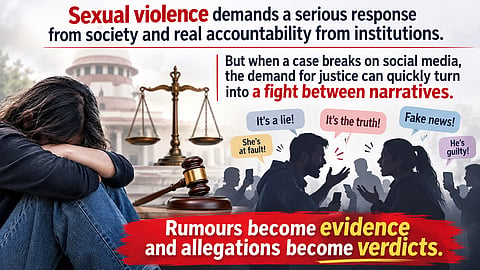


Sexual violence demands a serious response from society and real accountability from institutions. But when a case breaks on social media, the demand for justice can quickly turn into a fight between narratives. Rumours become evidence and allegations become verdicts.
The consequence is that the public outrage that is not pointed at the right target does not lead to justice.
Nothing highlights this better than the Kolkata 2024 RG Kar Medical College rape case.
On 9 August 2024, a 31-year-old postgraduate trainee doctor was raped and murdered while on duty at Kolkata's RG Kar Medical College and Hospital. The crime shocked the country. Doctors stopped work, women marched through the night, and the case dominated timelines for weeks.
Alongside the genuine grief came a wave of claims that turned out to be false. Posts said the autopsy had found 150 g of semen in her body and treated this as proof of a gang rape. As a column in ThePrint pointed out, 150 g was the weight of an organ listed in the post-mortem report, not a measurement of semen. Kolkata Police had to publicly fact-check this and other rumours, including claims about a fractured pelvis.
The Week listed a fake death certificate, unverified voice recordings, and a fake photo said to show the accused with the hospital's former principal. Alt News found that the man in that photo was someone else, and the picture was from 2020.
Junior doctors who had worked or eaten with her that night had their names and photos shared as the "real" killers. Some posts said they had fled the country. Police called rumours that junior doctors had gone "missing" baseless. In one case, Alt News traced viral "accused" photos to LinkedIn profiles of hospital staff, including an OT technician who had no link to the crime.
Indian law forbids revealing a rape victim's identity. Yet her name, photographs and videos spread across platforms. The News Minute reported that her photo even appeared on pornographic websites. The Supreme Court ordered the material taken down on 20 August 2024, and the Centre asked platforms to remove it.
In January 2025, a Sealdah court convicted Sanjay Roy, a civic volunteer attached to the police, and sentenced him to life imprisonment. The court found no evidence of gang rape.
This does not mean every public question was wrong. The same court criticised hospital authorities for trying to present the death as suicide, and police officers for how they handled the early hours. The victim's parents still seek the full truth. Obfuscated by invented details. The real failures were never scrutinised. Officials used the resultant confusion as an easy way to dismiss critics and dragged innocent people into a public trial.
Writing in The News Minute, Kalpana Sharma argued that once the case became a political battle, the core issue of the safety of women at work, especially doctors on night shifts in government hospitals, became almost an afterthought. She also noted that a nurse's rape and murder in Uttarakhand around the same time got only a fraction of the attention, simply because it happened far from big media markets.
When a report of sexual violence goes viral, people tend to split into two camps. One treats the report as settled fact and demands punishment straight away. The other insists on waiting for evidence. Both often reach their conclusion before fact can be sifted from fiction.
Algorithms make this worse. Posts that provoke the strongest emotion travel farthest, so the most dramatic version of a story — not essentially the most accurate one — reaches the most people. Within hours, a crowd has formed an opinion that no later correction can fully undo.
The RG Kar case is not unique. The same pattern shows up again and again.
The circulation of such reports on social media platforms has become more frequent. Users share sympathetic templates demanding justice, without considering the survivor’s consent to making the incident public or the possible consequences for their reputation and mental health. Unverified claims can also gain widespread attention, resulting in misinformation and public outrage.
The Supreme Court’s suo moto cognisance of recent rape cases in Delhi-NCR also drew attention to the responsibilities of media outlets when reporting such incidents. It cautioned them that headlines and reportage must prioritise dignity, factual accuracy and institutional accountability over sensationalism, ensuring that public discourse remains centred on responsible reporting.
Women safety should be the focus
The main issue surrounding such incidents, as Chawla pointed out about KG Kar incident, gets sidelined. Those issues of safety for women need to be the focus of discussions rather than drawing conclusions on the basis of mass-mentality narratives.
Let us not forget that sexual violence is not confined to anonymous public spaces. It frequently occurs within families, neighbourhoods, schools and workplaces.
According to the National Crime Records Bureau's 2024 data, 96.8 per cent of the accused persons in registered rape cases were known to the survivors. Friends, intimate partners, live-in partners, and other related categories constituted the largest category (47 per cent), followed by other known persons and neighbours (42.6 per cent), and family members (7.2 per cent). These figures highlight the importance of examining the wider social circumstances in which sexual violence occurs, rather than allowing public discussion to remain confined to individual incidents and competing online narratives.
Protests against such incidents are an important response but require the responsible use of online platforms. Social media should serve as a platform for raising voices rather than spreading false news and sympathetic templates to attract emotional attention.
It should alter the existing trend where a reported crime generates outrage through hashtags, demands for punishment are raised, and the issue eventually disappears from public attention. What remains is often a social media trend or hashtag rather than sustained public engagement. The demand for justice, expressed through public concern and solidarity, can make a system more robust and accountable.
Delhi gang rape encouraged conversations
The 2012 Delhi gang rape and murder, for instance, provides one of the clearest examples of how sustained public demand can push a society and its institutions towards change. The incident triggered widespread protest across India, which led the government to constitute the Justice J.S. Verma Committee to examine the changes needed in laws dealing with sexual violence. The committee received a number of recommendations from citizens, lawyers and women’s groups and subsequently submitted its report in January 2013.
Its recommendations covered sexual harassment, child abuse, medical examination of victims, police reforms and other institutional questions. The Criminal Law (Amendment) Act, 2013 subsequently introduced provisions concerning offences such as stalking, voyeurism and acid attacks, while expanding the legal framework dealing with sexual violence.
However, the responsibility for maintaining a credible public discourse does not rest with institutions alone. Media organisations and social media users must distinguish between verified information and allegations and users must recognise the consequences of circulating unverified reports and personal details. The authorities, meanwhile, must ensure that complaints are investigated promptly and that survivors receive the necessary protection and support.
Say no to verdict before trial
At the same time, reliance on due process cannot mean indifference towards survivors, just as solidarity with a complainant cannot mean declaring an accused guilty before the evidentiary process is complete. The two principles can coexist. A society can take an allegation seriously while allowing the facts to be established through a fair investigation and trial.
The Supreme Court’s intervention therefore reflects the importance of responsible reporting, institutional accountability and the protection of individual dignity. Social media can provide a space to question institutions, raise awareness and demand justice, but it cannot replace the procedures through which facts are established and accountability is secured.
When public outrage becomes the verdict, the discussion risks moving away from justice itself.
Have you liked the news article?
Support us now:
https://www.gofundme.com/manage/jammu-kashmirs-sole-independent-voice-under-threat