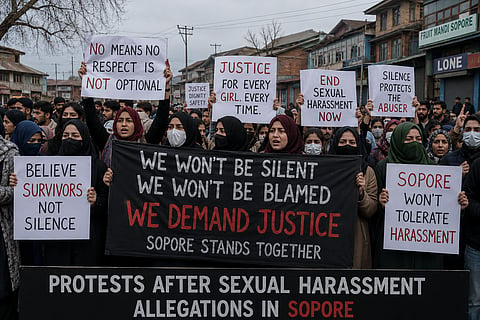


SOPORE: A sexual harassment allegation, a protest, a teacher suspended and detained, a town briefly paralysed, and six young men sent to jail under the preventive detention law. This is what unfolded on April 13, 2026, at Government Girls Higher Secondary School in Sopore. But there is more that is still missing beneath the detail.
On May 12, a court in Baramulla granted the teacher bail. This story is updated with details of the bail.
Everything about the incident is mired in murkiness even as it involves grave allegations and resulted in arrests under the controversial Public Safety Act (PSA). Conflicting accounts of what the allegation was and who made it persist. The families of the detained men say their sons were bystanders or had come looking for a sister. The students who say the protest was built on claims made in anger have since walked back. An official inquiry has now run past its own deadline with no findings made public and “no primary victim identified”.
What Began Inside a Classroom
On the morning of April 13, 2026, students at Government Girls Higher Secondary School in Sopore were attending regular classes. According to a Class 12 student, who spoke on condition of anonymity, the Urdu lecturer, Ghulam Hassan Mir, also known as Azhar, a resident of Rafiabad, Baramulla, was teaching a Class 12 Urdu lesson between approximately 11:20 AM and noon. It was during this window, or shortly after, that something altered the course of the day. Exactly what happened, and to whom did what, remains the central unresolved question.
Around midday, word began to circulate on campus that a teacher had allegedly harassed a girl. By approximately 12:30 pm, a protest had begun within the school premises, led by female students, senior students in the school revealed.
The Urdu lecturer was detained by police between approximately 1 pm and 2 pm, while demonstrations were still ongoing. Police have confirmed this timeline.
An FIR, registered as FIR No. 90/2026, was filed around the same period, during what Sopore Police described as the lunch break.
By the time the afternoon had passed, the school's internal protest had spilled onto the main roads of Sopore, triggering clashes, road blockades, and temporary shutdowns. Authorities subsequently shut the Higher Secondary School and Government Degree College in the area and deployed police to manage the situation. Approximately 20 individuals were detained in connection with the protests that day.
By April 24, six of those detained had been formally booked under the Public Safety Act (PSA) and sent to district jail in Bhaderwah. More than three weeks after the initial incident, the departmental inquiry into the original allegation remains unfinished and its findings have not been made public.
The Allegation: Multiple Versions, No Formal Complainant
The nature of the allegation at the centre of this incident is itself a matter of conflicting accounts and understanding it requires holding several versions simultaneously.
The complaint against Ghulam Hassan Mir was not filed by a student or a student's family. It was filed by the school's own administration - the Higher Secondary School authorities - following allegations raised by students inside the campus, according to Joint Director (North Kashmir) Hakeem Tanveer, who was appointed inquiry officer.
When Tanveer visited the school the following day, April 14, he said several students alleged incidents of what he described as "bad touch." However, at that stage, no single complainant had formally come forward. He confirmed that, as of the time of speaking, "no primary victim" had been identified during the inquiry, and that questioning of students was still ongoing.
The family most closely associated in initial reports with the allegation - that of a Class 9 student, a minor of approximately 14 years - has publicly denied that any incident took place. The girl's father said his daughter had felt unwell during the morning assembly and he had been called to take her to hospital, meaning she was not even present when the protest began at 12:30 PM.
He stated that neither he nor his daughter had filed a complaint with the police or in court, and that when police spoke to his daughter, she said nothing had happened to her. He described the allegations as "completely false" and said the teacher was innocent.
This account sits in tension with the broader picture emerging from the school. Tanveer's account that multiple students alleged "bad touch" on the day after indicates the allegation did not originate with a single incident or a single complainant, but with a more diffuse set of claims made by several students.
Whether those claims were coordinated, spontaneous, or influenced by the protest atmosphere is not established.
The Accused and His Family
Ghulam Hassan Mir was granted bail by a Baramulla court on May 12, a month after he was taken into custody, following the registration of FIR No. 90/2026 under Section 75 of the BNS and Sections 9/10 of the POCSO Act.
Ghulam Hassan Mir has been in custody since April 13. He is a lecturer who has served at the Girls Higher Secondary School in Sopore since 2009. He is also, by various accounts, a poet and author with a presence in local literary and religious circles.
His wife, Saleema Begum, described the moment she learned of his arrest. “On April 13, at around 4:00 PM, a villager asked me if my husband had returned home. When I said no, he told me that he had been arrested. I cannot describe the shock I felt…. my legs started trembling.”
She said her domestic life has turned upside down. Two of her sons are studying outside Jammu and Kashmir, and she fears that the “reputations of her three daughters are now imperiled by association with the allegations”.
When she first attempted to meet her husband on the evening of April 13, she was told his health was not well, his blood pressure had risen, but access was refused. She saw him the next day. She said he told her the allegations were baseless and that he invited authorities to examine both the CCTV footage of the school and his mobile phone. "He said if even a single piece of evidence is found against him, he is ready to face any punishment."
His daughter, speaking under a changed name, described the household since April 13 as feeling "like an orphaned place." She recounted a specific episode that she said had been distorted on social media: a photograph of her father placing his hand on the head of a female student who had won first prize in a calligraphy competition. This, the daughter explained, was “a clear act of appreciation that she said was subsequently edited, stripped of context, and widely circulated with inappropriate material attached.”
"When I saw it, I was shattered. I could not even turn on the internet for eight days."
He was granted bail by the Principal District and Sessions Judge after his lawyers argued that the investigation material and witness statements did not establish any incriminating role.
Students' Accounts: Doubt, Retraction, and Unanswered Questions
The student accounts that have emerged since April 13 complicate the picture further and several point in a direction contrary to the allegation.
A Class 12 student, Naveeda (name changed), who said she had studied at the school for four years, noted that the Urdu lecturer taught only Class 11 and 12 students. The allegations, she said, had been raised by students from Class 9 and from the medical stream - students who had no classes with him. She also noted the timing: if he was teaching a Class 12 Urdu lesson from 11:20 AM until Noon, it was unclear how a Class 9 student could simultaneously have an encounter with him.
After the school reopened, confirmed to have been two days after the incident, Naveeda said, she heard many students say the allegations were false. Some of the girls who had led the protest, she said, were now saying they had spoken in anger and regretted what they said, and many were refusing to discuss the incident further.
A Class 11 student, also speaking anonymously, said she had never seen the teacher behave inappropriately and had always found him "disciplined, polite, and respectful."
The lecturer had reportedly been strict about the ban on mobile phones on campus and had recently confiscated a student's phone. "Many believe this may have contributed to the situation escalating," she said.
Neither account can be taken as definitive. Students distancing themselves from an allegation after the fact is not the same as the allegation being false. The "bad touch" claims described by the inquiry officer, made by multiple students on April 14 as confirmed by him, exist alongside these retractions.
The Protests: From Campus to Road
The timeline of April 13 appears to have two distinct phases. The first was internal. Demonstrations began inside the school campus around 12:30 PM, led by female students.
The second was external and more volatile. According to Sopore Police, when students moved out of the campus onto the main road, students from nearby schools and outsiders also joined. It was this second phase that produced the clashes, blockades, and shutdowns that gripped Sopore through the afternoon.
The school education department suspended the lecturer and registered the FIR the same day. In the days that followed, concerns were raised by students and families about the pace and transparency of the inquiry.
The PSA Detentions: Six Youths, Two Families, One Lawyer
By April 24, Sopore Police had formally booked six youths under the Jammu and Kashmir Public Safety Act and transferred them to district jail in Bhaderwah. The six named in a police press note were: Umar Akbar Hajam (Seeloo, Sopore), Muzamil Mushtaq (Arampora, Sopore), Altaf Ahmad Sheikh (Pinjipora, Tarzoo), Bashir Ahmad (Chinkipora, Sopore), Majid Firdous Dar (Chinkipora, Sopore), and Salman Ahmad Shalla (Shalpora, Sopore).
Police said the six were identified through video footage allegedly showing vandalism of school property - broken vehicle mirrors belonging to staff, damaged chairs, and broken windowpanes and mirrors inside the school.
They maintained that those booked under the PSA were not students of the school but "outsiders" allegedly involved in violence, and that the sequence was: identification through footage, registration of FIRs, and subsequent PSA detention.
Police described the detainees as "actively involved in encouraging unrest, indulging in vandalism, and seeking to disturb peace," and stated that more individuals were being identified and could face similar action. Authorities reiterated a "zero tolerance" approach and warned against attempts to "exploit sensitive situations."
The families of two of the detainees have given accounts that conflict with this characterisation.
Haneefa Begum, mother of Umar Akbar Hajam, 22, said her son had studied until Class 9 and had recently started working at a salon. Police came to her home on April 16 at around 9:00 AM, she said, and told her they only needed to question him.
She learned of his PSA detention only when the press note was issued on April 24. "They told us he was involved in vandalism and protest, but they did not show us any evidence or footage," she said. "He is the only breadwinner of our family, and before this, he was never involved in any case."
Huzaif Ahmad Shalla, brother of Salman Ahmad Shalla, 23, said his brother was a vegetable vendor who had gone to the protest area on April 13 because their sister studied at the school and he was worried for her safety. He was taken by police during the protest. That evening, the family received a call saying Salman had been injured and was at the police station and would return home after treatment.
His PSA detention was also only confirmed via the April 24 press note. "If there were hundreds of boys present, why were only these six booked?" his brother asked. "I also saw a video in which my brother was just standing at the protest; he was not holding any stones or involved in any damage."
Human rights lawyer Shah Faesal challenged the use of the PSA in this context. "The protests are part of constitutional rights," he said.
"If some individuals caused damage, they could have been dealt with under normal law. PSA is meant for serious threats to public order or state security." He argued that FIRs and standard criminal procedure would have been the appropriate first response, allowing individual responsibility to be established through due process.
"Preventive detention is an exceptional measure and should not be the first response in situations that can be handled through ordinary law." He noted that preventive detention laws significantly curtail the procedural safeguards available under ordinary criminal law, making, in his view, their restrained application even more important.
What Remains Unresolved
More than three weeks after April 13, the inquiry into the original allegation is still pending. Joint Director Hakeem Tanveer, when contacted, said the report may take around ten more days, that questioning of students is continuing, and that no primary victim has been identified so far.
The incident, as it now stands, contains at least three unresolved threads running in parallel and they have become entangled in ways that make each harder to examine clearly.
The first is the allegation itself: a set of "bad touch" claims made by multiple students, with no formal complainant, no identified primary victim, a school administration that filed the complaint rather than a student or family, and a growing number of student voices now say the allegations were made in anger and do not reflect what happened.
The second is the law-and-order response: the use of the PSA against six young men whose families say they were either uninvolved in violence or present only incidentally, and against whom no evidence has been publicly produced. Whether those detentions were proportionate and legally justified, or whether ordinary criminal procedure would have been sufficient, is a question the legal community has begun to raise.
The third is the question of accountability for the original allegation itself: as attention has shifted toward the protests and the PSA detentions, what happened on the morning of April 13 inside the school and who, if anyone, was responsible, has quietly been lost in the oblivion.
(This news article has been updated on May 13, 2026, after the teacher was granted bail by the court in Baramulla. This report attempts to set out, as fully as possible, all the contradictory versions - what is being said by whom and to map the available information to lend it as much clarity based on the available information. It will be updated when there is more information to fill in the gaps.)
Have you liked the news article?
Support us now:
https://www.gofundme.com/manage/jammu-kashmirs-sole-independent-voice-under-threat