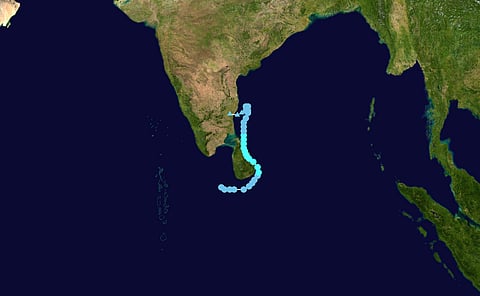


Cyclone Ditwah that slammed into Sri Lanka on November 28, triggering torrential rains that killed over 400 people and displaced nearly 15 lakh, is not only a grim reminder about the existing climate change threat. The mishandling of the crisis is also a warning for the country, and by extension rest of South Asia, about the sheer lack of disaster preparedness and lack of political will, which is endemic to the region.
Like all other past natural disasters, now increasing in their frequency and fury, Cyclone Ditwah lay bare the failures that are so systemic and recurring across South Asia. From earthquakes to floods to cyclones, it is the same old tiring script: The gap between the knowledge of the impending cyclone and the warnings, political callousness, bureaucratic hurdles in making emergency services, rescue and relief accessible, and a system designed to disproportionately make some classes of society more vulnerable.
Sri Lanka’s Dismal Response
The meteorology department in Sri Lanka issued its first public warnings on November 12. Red alerts predicting very heavy rainfall came out on November 25. The meteorological warnings should have triggered immediate preparations across all levels of government, but apparently that never happened despite an adequate time of two weeks.
The government's response remained paralysed until the tide had taken over the island country and devoured its people and their homes. Much worse, Government offices were closed for a special holiday even as people desperately tried to reach emergency services. According to different media reports, the president joined an emergency meeting two days later, by which time people in affected areas were just beginning to receive their first warnings about possible heavy rain.
The major brunt was borne by the Tamil-speaking communities in the north and east, who received no warnings in their own language, and hence could not understand the urgency of preparedness. An information vacuum exacerbated the devastation in the region that has been war-torn and home to fragile connectivity. The scale of destruction was evident in collapsed bridges, completely broken supply lines, and homes buried under floods and landslides.
What made this tragedy particularly damning is that the cyclone was not even a powerful storm by meteorological standards. With wind speeds of only 65 kilometers per hour, it was classified as a weak tropical cyclone, and there were advance warnings that were not adequately and effectively disseminated. The country’s disaster management was visibly not geared up for the occasion.
South Asian Consistency
Sri Lanka’s failures are not confined to its borders. They are mirrored across South Asia with a stubborn consistency.
In Pakistan, repeated floods in recent years have exposed equally catastrophic breakdowns in disaster management. The 2025 floods in Khyber Pakhtunkhwa claimed over 400 lives locally and 788 nationwide, while the 2024 Sindh floods left thousands abandoned in disease-ridden camps. In both cases, early warning systems that existed on paper failed to reach vulnerable communities. Disruptions in the communication infrastructure left entire villages cut off from emergency services. Government responses were marked by poor coordination and delayed relief, betrayed evident patterns of discrimination against the rural and marginalised communities.
Change the dates and the piece of geography. And this reads like an Indian story. In 2024, 3,400 lives were lost to different disasters across the country. In 2025, cloudbursts, floods and landslides similarly played havoc with lives and property in the Himalayan belt – from Jammu and Kashmir to Uttarakhand. In Punjab, 1300 villages were submerged, dozens killed, and over 3 lakh people impacted.
Reports of corruption, favoritism in aid distribution, and mismanagement to the point of eroding public trust in institutions entirely are familiar threads in every tragedy, both in India and Pakistan. Survivors remain without adequate relief and rehabilitation assistance; the poor remain far more vulnerable with poor relocation mechanisms, while the better off can afford to move to safer areas.
A poor disaster management response in all these countries is particularly shocking. Sri Lanka, India and Pakistan have adopted the Sendai Framework for Disaster Risk Reduction (2015-2030), which is a 15-year UN agreement that establishes four priority actions and seven global targets aimed at reducing disaster-related mortality, economic losses, and affected populations.
Despite adopting this framework, many South Asian countries continue to struggle with poor disaster preparedness, failing to implement effective response mechanisms and building resilience infrastructure. In practice, there is a massive gap between policy intentions and the ground reality, particularly in the case of marginalised communities, turning disaster into a human catastrophe.
This is less due to a lack of resources and technical capabilities and more due to bureaucratic incompetence, and the entrenched systems of discriminatory oppression. In most cases, the disaster management mechanisms reinforce the same existing hierarchies, to the disadvantage of those who most need support.
Lack of Will and Politicisation
Political action and willingness matter too. The recent Nepal experience serves as a lesson. Nepal's 2025 flood response under interim Prime Minister Sushila Karki featured early warnings preemptive highway closures, and advance deployment of personnel and equipment, which minimised the casualties to dozens despite intense rainfall, revealing that effective disaster management is possible when political will exists.
In striking contrast to this, the Sri Lankan response to disaster management, beyond being dismal, is shocking in the way the disaster was weaponised to strengthen the powers of the government by placing emergency regulations to crush dissent and thus stonewall questions of accountability. This was similar to the way in which the Indian government used the Covid pandemic to politicise the crisis through suppression of criticism, mishandling of distribution of aid, and targeting of minorities.
The Way Forward
South Asia needs to face some uncomfortable truths as disasters have begun striking with an increased frequency. Disaster management cannot be a shoddy response that is a cover-up or a tool for politicisation. While the systems need to be better geared up to meet the challenges, there is also need to dismantle the entrenched systems of oppression through decades of marginalization of some communities, enhancing their disaster vulnerability.
The commonality of the challenges necessitates more co-operation, sharing of disaster-related data in a shared geographic landscape, and designing an effective response that factors in traditional knowledge systems. Beyond saving lives and property through a better co-ordinated disaster management response, South Asian governments also need to reckon with the reality staring in the face – that climate change is real and its root causes need to be addressed. That would need more political will and co-operation.
Instead of turning our backs to each other, our collective responses should be rooted in the shared concern and empathy for human lives, irrespective of socio-economic hierarchies.
Have you liked the news article?
Support us now:
https://www.gofundme.com/manage/jammu-kashmirs-sole-independent-voice-under-threat