

JAMMU: Within the span of less than a week, Jammu & Kashmir has been shaken by a cluster of deaths, and in each case, families, students and civil society are asking not merely why lives were lost, but who failed to prevent them.
From an overloaded bus tumbling into a Himalayan gorge, to a young college student falling from a moving vehicle on a picnic trip, to a road accident victim allegedly left to die slowly in a hospital casualty ward, the pattern of alleged negligence has triggered protests, government inquiries and calls for accountability across the region.
21 Dead, 61 Injured and Questions About Overloading
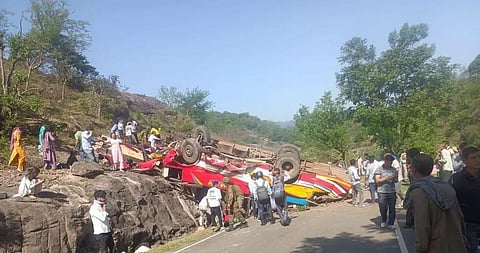
The week's most devastating incident came on Monday morning when a private bus carrying a large number of passengers plunged nearly 100 metres down a hillside in Udhampur district, crushing an autorickshaw on the road below before coming to rest upside down. At least 21 people were killed and 61 injured in what is among the deadliest road accidents in the Jammu division in recent years.
The bus had been negotiating a blind curve near Kagort village in Ramnagar at around 10 AM when the driver appears to have lost control. The vehicle struck a parapet wall before rolling into the gorge below. An army convoy that happened to be passing through the hilly stretch was first on the scene, with soldiers pulling out survivors and organising evacuation before police and local residents arrived to assist.
"We saw survivors crying inconsolably, waiting for someone to rescue them," an army officer at the scene said.
Deputy Inspector-General of the Udhampur-Reasi Range, Shiv Kumar Sharma, said preliminary investigations indicated the driver lost control while taking the sharp curve. Crucially, authorities are also investigating reports that the bus was overloaded, a factor that would have made control of the vehicle on a narrow mountain road far more difficult and that raises serious questions about enforcement of transport regulations on these routes.
Among those confirmed dead are Tilo Ram, Prem Nath, Kartar Chand, Som Raj, Ram Chand, Gita Devi, Romal Singh, Sharda Devi, Sunny, Vishali Devi, Pushap Raj, Ramolo Ram, Gulabo Devi, Jalam Singh, Kesar Singh, Kanta Devi and Anita Devi — all residents of the Ramnagar area.
Most injured were taken to Udhampur Hospital, with two critically injured patients transferred to Government Medical College, Jammu. Prime Minister Narendra Modi expressed grief over the deaths and announced ex-gratia relief of ₹2 lakh for the families of the deceased and ₹50,000 for those injured. Chief Minister Omar Abdullah said the government stood firmly with the victims and their families.
Yet the condolences and compensation do not address the underlying question: if the bus was indeed overloaded, why was it allowed to operate on a treacherous mountain route without inspection?
The roads of Jammu and Kashmir's hilly districts have been the site of recurring bus tragedies, and critics have long argued that routine overloading of passenger vehicles, lax enforcement of fitness certificates, and the absence of adequate safety infrastructure on blind curves remain perennial and unaddressed problems.
A Picnic, a Rear Window and a Demand for Justice
Five days before the Udhampur gorge disaster, another bus-related death in the same district had already set off waves of public anger.
On April 16, Anjali Choudhary, a 20-year-old fourth-semester Physics student at Government College for Women (GCW) Gandhi Nagar in Jammu, died after falling from the rear window of a moving bus near Udhampur city at around 10:30 AM. She had been travelling with fellow students on a college-organised picnic to the popular hill resort of Patnitop.
Eyewitnesses said Anjali fell from the bus's rear window, though the precise reason for her fall was not immediately established. She suffered a fatal head injury. The picnic was immediately cancelled and all buses returned to Jammu. A police case was registered.
The death of a young woman on what should have been a celebratory college outing struck a nerve. Education Minister Sakina Itoo expressed sorrow and directed authorities to assist the bereaved family. But within days, it became clear that grief had curdled into anger among Anjali's fellow students.
On Monday, the same day as the Udhampur gorge accident, hundreds of female students from GCW Gandhi Nagar staged a loud, sustained protest outside their college, boycotting classes and sitting in a dharna on the highway, disrupting traffic for two hours before police restored order. They demanded the suspension of the teachers who had accompanied the picnic, alleging that negligent supervision had directly contributed to Anjali's death.
"We want the administration to act and provide justice. Those behind the negligence which resulted in Anjali's death must be held accountable. We want their suspension," one agitating student told reporters.
The protest raised questions that go beyond one tragic incident. College picnics involving large numbers of students in moving vehicles on mountain roads require clear safety protocols, supervision of students, secure seating, windows that cannot be opened unsafely, and staff accountability.
Whether any such protocols were in place on April 16, and whether those responsible for student welfare fulfilled their duty of care, is precisely what protesters are demanding be investigated. So far, no suspensions have been announced, and no teacher has been publicly named in connection with the inquiry.
A Family's Allegation of Fatal Delay
A third incident has added another dimension to the negligence debate inside a hospital.
On Saturday evening, Bilal Ahmad Mir, a 35-year-old resident of Yarhole-Baihama village in the Qazigund area of Anantnag district, was injured in a road accident near Ashajipora and taken to Government Medical College (GMC) Anantnag for treatment. He died at approximately 11pm. His family alleges he was a victim not only of the accident, but of the hospital's failure to treat him in time.
"He was struggling for life, but no immediate response was given. If proper and timely treatment had been provided, he might have survived," a family member said, according to Kashmir Life. They alleged that Mir arrived at the hospital around 7pm and was taken to surgical casualty, but that there were significant delays in conducting diagnostic tests like X-rays, ultrasound and other scans, during the critical window between his arrival and his death some four hours later.
The hospital has denied the allegations, stating that all standard operating procedures for treating a road trauma patient were followed, including the Advanced Trauma Life Support (ATLS) protocol. GMC Anantnag said that CT scans, ultrasound and chest X-rays were performed and found to be normal, and that the patient was cleared by the surgical department before being handed over to the orthopaedic team for management of a pelvic fracture.
The competing accounts are now the subject of a formal government inquiry. Health Minister Sakina Itoo announced the constitution of a three-member committee under Government Order No. 354-JK (HME) of 2026.
The panel is headed by the Mission Director of the National Health Mission and includes the Director of Health Services Kashmir and the Medical Superintendent of Children's Hospital Bemina among its members. The committee has been directed to examine staffing levels at GMC Anantnag at the time of the incident, review whether medical response was adequate, determine accountability for any shortcomings, and submit a report within one week.
"If any negligence is found, strict and exemplary action will be taken against those found guilty," the Health Minister said.
A Pattern Demanding Systemic Answers
Taken individually, each of these cases might be attributed to misfortune. Taken together in the same region, within a single week, they point to questions about systemic failures that recur with grim regularity in Jammu & Kashmir.
In each case, official responses have evoked condolences from the Prime Minister and Chief Minister, directions for inquiry from ministers, expressions of solidarity with bereaved families.
Whether the formal inquiry committees constituted this week will deliver that accountability, or whether their reports will be quietly filed away as has happened with similar investigations in the past, remains to be seen.
Have you liked the news article?
Support us now:
https://www.gofundme.com/manage/jammu-kashmirs-sole-independent-voice-under-threat