

(This news article is two-part series and Part-I is published today.)
The road simply ended, just three or four kilometres from my village.
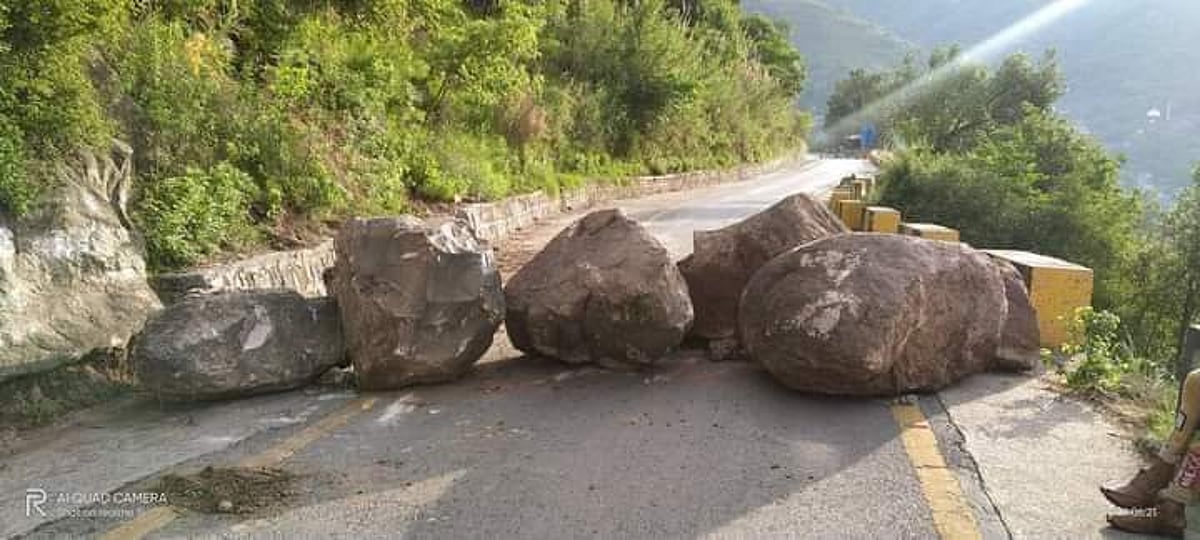
Massive boulders sat in the middle of the coal-tarred road, leaving a gap barely wide enough for a motorcycle to squeeze through. Night had fallen. On the other side of the rocks stood the young men who had put them there – volunteers and sympathisers of the Jammu Kashmir Joint Awami Action Committee (JKJAAC).
They explained, politely, that the barricade was for public safety. Security forces were trying to reach Rawalakot to break up the sit-in, and this road was one of the ways in.
"How can we get home, then?" I asked, as gently as I could.
One of them smiled, took out his phone and made a call. After a short wait, a vehicle pulled up on the far side of the barricade. Then every volunteer there picked up a piece of our luggage. They carried our bags across the boulders on foot and loaded them into the waiting car. As our new driver started the engine, one of them shouted from behind, “Charge them a fair fare”.
I had crossed half the world to attend my youngest sister's wedding. I came home to find my land under a people's lockdown, its roads sealed by its own sons. And those same sons were hauling my suitcases over the rocks so that I could reach my mother's door.
I grew up in a village near the Line of Control (LoC) in the Poonch district of Pakistan-administered Jammu and Kashmir (PaJK). It is a borderland where politics centred on the whole of the former princely state of Jammu and Kashmir runs deep. Student politics is officially banned in Pakistan and the territories it administers, but in Poonch it is almost impossible for a young person to stay out of it.
I joined my first student organisation in Grade 9. It was a step onto an unpredictable path, and it worried my parents and my extended family for years. Over time, my thinking moved to the left, and I eventually joined a left-wing political organisation in PaJK. In a region shaped by heavy religious indoctrination, secular and leftist groups are seen as especially dangerous. For many people, calling yourself secular is enough to be branded an infidel.
After university, as I entered the workforce, I poured that energy into reading, writing and digital activism.
In 2022, I emigrated to Canada. The distance did not cut me off from the struggle at home. It pushed me further into writing. I called out the failures of PaJK's political leadership and bureaucracy, sometimes with restraint and sometimes with sharp criticism. To close the geographic gap, I started a regular broadcast on Facebook and YouTube, inviting activists from home to discuss current events and pressing social and political issues.
When I began planning a visit home, I put the show on hold. With my parents and extended family still living there, I have always had to walk a narrow line between speaking out and keeping the people I love safe. This summer, the line narrowed further.
Before June 2026, my younger brother and I had already settled our travel plans. Our family had told us that our youngest sister would marry in mid-August. For weeks we talked through every detail of the arrangements with them, and the feeling was the same on every call – a mixed blend of excitement, joy and responsibility. We were happy to welcome a reasonable number of guests in the baraat from the groom's side. The groom himself would travel shortly after us and arrive a day later.
Nothing at that point suggested that PaJK was about to descend into chaos.
Then came June 5 to 10. After those days, my brother and I were both afraid to travel.
Most of my close friends knew I planned to fly home. When the unrest broke out, they first told me to go slow on Facebook and X. Then, as more and more JKJAAC sympathisers were placed on the Fourth Schedule and the Exit Control List, the advice hardened to not a single post and not one status.
I would be travelling on a Canadian passport, but that offered little comfort. The Pakistani state has a long record of targeting rights-based activists. We believed that even one Facebook post could stop me from getting back to Canada. I took my friends' advice, and I passed the same warning straight on to my brother and to my future brother-in-law.
When the events of June 5 unfolded, I documented what happened. In public, I kept my words measured and polite.
Silence on social media never meant I gave up working for a lasting peace in the region. It meant moving the work somewhere quieter. With a group of friends and acquaintances spread across the globe, I began formally reporting events in PaJK to human rights organisations.
We approached the mainstream political leadership of PaJK and urged them to open negotiations with the protesters sitting in Rawalakot. At the same time, friends experienced in mediation pleaded with the JKJAAC leadership to postpone the long march, because state violence kept claiming the lives of unarmed protesters in Rawalakot.
We also asked saner voices in Pakistan to speak up. Maulana Fazal-ur-Rehman, Shahid Khaqan Abbasi, Mahmood Khan Achakzai, Allama Raja Nasir Abbas, Hafiz Naeem-ur-Rehman, Khawaja Saad Rafique, Senator Mushtaq Ahmad, Mustafa Nawaz Khokhar and several other compassionate people responsibly raised their voices. A delegation of Pakistani opposition leaders even set out for Rawalakot in solidarity. The state stopped them before they arrived.
It seemed the "real state" had decided to rule with an iron fist. Every written appeal we sent to the Government of Pakistan through mediators came back, after a while, with the same blunt answer that ‘the establishment was not convinced’.
After each attempt, we sat down again to analyse what had happened. Each time the feeling was the same helplessness and frustration, the sense that everything we did was in vain.
In the UK and Europe, friends were organising rallies and demonstrations in support of the JKJAAC. Whenever we could, we asked them to temper their slogans and not to openly provoke the people in power, the Pakistani establishment above all. Our reading was that diaspora activism in the UK and EU was fuelling the anger in Islamabad. For asking people to keep their dissent polite, I was attacked by social media activists as naive and a coward.
Brutality of July 27
Then came July 27, and the mass killing of protesters in Rawalakot.
Everyone in our circle of friends, and everyone in my family, was weeping. A friend in Saudi Arabia called to tell me that Usama Jamil had been killed, and I could not hold myself together.
Later I watched a video he had recorded before his death. It is clear from it that Usama knew. He knew he would be shot if the protesters tried to enter Rawalakot city.
After July 27 and 28, the warnings to me grew more urgent. The internet was shut down across all of PaJK, and only basic mobile service still worked. Through that thin line my mother called me again and again, asking me to stay calm and composed, and to keep away from angry posts online.
On August 6, I packed my bags and set out.
When I landed in Islamabad, I called my younger brother, whose flight from the Middle East had arrived a little earlier. The moment the call connected, I asked, "Did they check your documents thoroughly?" He sounded puzzled, as if he had not expected such a naive question from me. Nothing like that had happened, he said.
Home is 140 kilometres from Islamabad airport, about four hours by road on a normal day. But my oldest brother, who had come all the way to Islamabad to collect us, advised against setting off straight away. The roads were not safe.
The next day another family joined us, and thirteen of us began the journey to PaJK together.
After Rawalpindi, we stopped to eat at a restaurant near the border between Punjab and PaJK. I asked the manager if I could use the Wi-Fi. He smiled and apologised. The Punjab Police had cut the restaurant's DSL connection, he said. Because the owner was Kashmiri, the authorities suspected he was letting JKJAAC sympathisers upload protest videos and photos to Facebook and other platforms.
At Holar Bridge, near the Karot Hydropower Project, the PaJK police ran a checkpoint, but nobody searched us closely. Once we crossed into PaJK, I noticed something missing. I had watched past elections in the Kotli, Mirpur and Bhimber districts, where electoral battles were fierce and candidates spent huge sums covering every surface with panaflex banners, posters, stickers and billboards. This time, after the recent PaJK elections, there was almost nothing. It was as if hardly anyone had bothered to campaign.
What lined the roads instead was debris. From Holar to Kotli, and from Kotli to Tatta Pani, rocks and felled trees lay along the roadside. I asked our driver about them, wanting to know how far ordinary people were involved. He smiled. Local people had put them there, he said, to keep security forces out of their towns, and above all to stop them reaching Rawalakot.
Past Tatta Pani, the usual road into Poonch was closed. Huge piles of mud had been dumped onto a bridge, so we took another route that runs along the Line of Control. At Sehra, my brother pointed out a bridge that locals had damaged to stop security forces advancing towards Rawalakot; a temporary detour let ordinary vehicles cross.
In Sehra, we met our first people's chowki, a citizens' checkpoint. Young men were checking the identity card of every passenger. I tried introducing myself as a friend of a local resident, but they would not simply wave us through. They believed security personnel were travelling in private cars and civilian clothes to join an operation against the JKJAAC in Rawalakot. Once they had checked our IDs, they let us go.
In all of Poonch, I did not see a single election poster or banner.
The closer we got to home, the less certain everything felt. Then we reached the boulders, three or four kilometres from our village, and the volunteers who carried our bags across them.
In the second car, we drove along the same winding roads I had taken to school as a child. It was nearly midnight. A large group of young men sat in the road, half blocking it. When they recognised familiar faces in our car, they pushed the concrete blocks aside and let us through.
At last we were home. With no internet, I had no way to tell my friends and family in Canada that I had arrived safely.
Have you liked the news article?
Support us now:
https://www.gofundme.com/manage/jammu-kashmirs-sole-independent-voice-under-threat