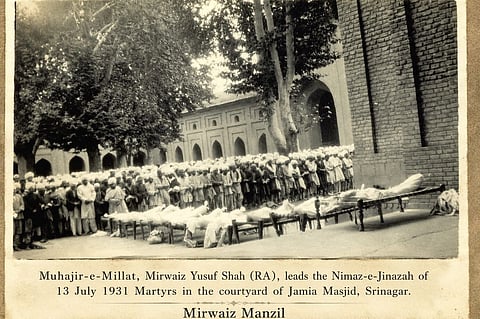


SRINAGAR: July 13, 1931. A crowd gathered outside the central jail for what could have been a routine hearing. The defendant was a man almost nobody in Kashmir had heard of earlier till a few days ago: Abdul Qadir, whose identity remains contested - an Afghan Pathan tourist, a Kashmiri, a butler from Uttar Pradesh - arrested after delivering an unscheduled speech at a political rally calling on Kashmiri Muslims to rise against Dogra rule.
By the time his trial opened, he had become a symbol. The crowd outside chanted against the state. Dogra police open fire. Twenty-two people are killed and hundreds wounded — the first mass casualties of a decade-long political awakening that will remake the princely state of Jammu and Kashmir.
The man who would come to dominate the story told about that decade, Sheikh Muhammad Abdullah, was rising to prominence that very summer and would go on to lead it. But the fuller record in her book Kashmir in the Aftermath of Partition (Cambridge University Press) - reconstructed from court files, memoirs, and Kashmiri newspapers by historian Shahla Hussain - shows a far more crowded stage: a widow who fought back against an armed officer with a fire pot and paid for it with her life, a Jammu leader, journalist and intellectual Prem Nath Bazaz and many more.
Grievance Years and Firing at Central Jail
By 1931, decades of misgovernance, discrimination, and neglect had brought Kashmiri Muslim discontent to a boil. Specific incidents sharpened the mood: in Jammu, police had refused Muslims permission to use a plot of land for prayer, and word spread of a Hindu constable who had interrupted an imam's Friday sermon and disrespected a copy of the Quran. Hindus made up roughly five percent of the Valley's population yet held a disproportionate share of government jobs, feeding a broader sense among Muslims of exclusion from a state their labor sustained.
In June 1931, the Reading Room Party, a coalition of clergy, merchants, and professionals, rallied at Khanqah-i-Mohalla in Srinagar to choose a delegation for the maharaja. As the main speakers dispersed, an unknown figure named Abdul Qadir urged Kashmiri Muslims from the platform to revolt against Dogra rule. He was arrested for provoking communal disorder.
When his trial opened at the central jail on July 13, sympathizers gathered outside chanting against the state. Police opened fire, killing twenty two and wounding hundreds. Mourners carried the dead in procession to the Jama Masjid.
Some then turned on Kashmiri Hindus, destroying businesses and moneylenders' ledgers. The worst violence centered on Maharaj Gunj, a market dominated by Punjabi Hindu traders whose capital and protected trading privileges had squeezed out Muslim merchants.
The unrest also reflected the Great Depression, which had crushed demand for Kashmiri shawls and carpets and left artisans indebted to Hindu moneylenders. Economic desperation, not only communal anger, drove the crowds.
The Women on the Streets
By August, an uneasy truce had taken hold. The state agreed to bail rioters and reinstate suspended Muslim officials in exchange for a promise from Muslim leaders to end the agitation. For many who had lost husbands, brothers, and sons on July 13, or were beaten and jailed, the truce looked like surrender. It was women, not the men negotiating on their behalf, who refused to accept that the fight was over.
In the neighbourhoods of Maisuma and Gawkadal, women whose male relatives - often their households' sole earners - had been killed, injured, or imprisoned took to the streets themselves, marching through Srinagar and singing songs against the zulum, the tyranny, of Dogra rule.
Among them was Freechi, a thirty-five-year-old widow whose husband had died in the July firing. She became a fixture of nearly every procession that followed. When police began beating women demonstrators on one occasion, Freechi fought back, hurling a lit kangri into an officer's face and disfiguring him for life. Police responded by opening fire on the women, killing Freechi along with four other women and two children.
Freechi's name rarely appears in the histories built around Sheikh Abdullah's rise. But her willingness to physically confront an armed officer, and the price exacted for it, marked one of the earliest instances of sustained women's participation in Kashmiri street politics, a role women would continue to play through the decade's agitations, largely without credit.
That September, thousands of Kashmiris marched through Srinagar from the Dastageer Sahib shrine bearing axes, spears, and lances. The Maharaja answered with an emergency ordinance, Notification No. 19-L, permitting warrantless arrests and seizure of property, with penalties including imprisonment and flogging, carried out publicly at Srinagar's exhibition grounds. The crackdown only hardened Muslim resistance.
The Valley and Beyond
News of the firing traveled fast, and outside actors moved quickly to claim the Kashmiri cause. In Punjab, two rival Muslim organizations competed for leadership of the movement. What had been the All India Muslim Kashmiri Conference was reconstituted in 1931 as the All India Kashmir Committee under Bashir-ud-din Mahmud Ahmad, the Khalifa of the Ahmadiyya community, who saw the Valley as fertile ground for both civil-rights advocacy and religious conversion.
The Committee funneled propaganda and funds to Abdullah's circle in Srinagar, though the maharaja's government repeatedly refused its requests for direct talks. Its rival, the anti-British urban Muslims and reform-minded clergy, Majlis-i-Ahrar, with ties to the Indian National Congress took a more confrontational approach, launching the "Kashmir Chalo" movement that sent some 2,500 volunteers across the border into Jammu in organized bands, deliberately courting arrest to keep the cause alive.
That campaign found unexpected resonance in one of the state's most overlooked corners. In the border region of Jammu and Mirpur, Muslim peasants long burdened by heavy Dogra taxation rose in a revolt of their own, inspired by the volunteers pouring in from Punjab. It was a sign that the "Kashmir movement," even in its opening year, was never a single, Valley-centered story.
Facing unrest it could not suppress, the maharaja appealed to Britain, which insisted on an inquiry. The Glancy Commission, formed in November 1931 with two Muslim and two Hindu members, recommended restoring Muslim shrines, more Muslim teachers, and fairer hiring, plus peasant land rights. Yet the reforms benefited the Muslim professional classes far more than the rural poor whose anger had forced the inquiry.
Two Lions, Two Camps
In October 1932 came the Muslim Conference, formed to advance Muslim interests, with Abdullah allying with Jammu's Muslims through the Young Men's Muslim Association under Chaudhry Ghulam Abbas. The party was initially loyalist, seeking only "responsible government" under the maharaja, even as Abdullah's 1933 address already reached toward non-Muslims and "oppressed classes."
Unity did not last. Mirwaiz Yusuf Shah wanted to sever ties with the Ahmadiyya-linked Kashmir Committee. Abdullah, valuing its funds, refused. A separate dispute over shrine worship turned violent in 1932, with Abdullah backing rival cleric Mirwaiz Hamdani. Yusuf Shah retaliated by branding Abdullah an Ahmadiyya, forcing him to break with the Committee.
The rift deepened when Yusuf Shah accepted a maharaja's honorarium, seen as proof of compromised loyalty. He quit in 1933 to form the Azad Muslim Conference, splitting Srinagar's Muslims into "Shers" and "Bakras," with routine street fights draining the movement's momentum. A 1934 legislative assembly excluded most peasants: only men paying twenty rupees yearly in land revenue could vote.
Needing a majority, the Conference had to court the Hindus and Sikhs its name seemed to exclude. Hindus, five percent of the Valley yet holding outsized government jobs, largely resisted, with groups in Jammu like the Yuvak Sabha launching a "Roti Agitation" against Muslim employment gains. Some Hindus, however, argued that solidarity, not opposition, better served their community's interests.
That disagreement would shape Kashmiri politics for the rest of the decade, in no small part through the efforts of one newspaperman.
The Hindus who Joined the Movement
Born in 1905, the same year as Sheikh Abdullah, to a middle-class Kashmiri Pandit family, Prem Nath Bazaz graduated from Punjab University in 1927 and took a job supervising a Srinagar girls' school. He entered politics as president of the Yuvak Sabha, then a loyalist organization devoted to cultivating "patriotism" toward the Dogra ruler - a starting point that makes his later break from the Pandit mainstream all the more striking.
The Hindu-Muslim riots of the early 1930s left Bazaz shaken, and his response cut against his own community's instincts. He shared Pandit fears that Kashmiri Muslims' growing ties to "pan-Islamic" groups in Punjab could tip the Valley toward theocracy.
But he broke decisively with Pandit orthodoxy in arguing that his community's hostility to Muslim demands was self-defeating, urging fellow Pandits to take a leading role in Kashmiri resistance so as to steer it along what he called a "saner path" rather than watch it from the sidelines. He became a close friend and advisor to Abdullah and faced threats of excommunication from his own community.
Above all, Bazaz built institutions. He launched the newspaper Vitasta in 1932, then Hamdard in 1935 jointly with Abdullah, and later Voice of Kashmir in 1959, using each to press an explicitly secular, class-based politics. Hamdard urged readers to retire the vocabulary of "Hindu" and "Muslim" altogether in favour of "oppressor" and "oppressed" - categories, the paper argued, that cut across every community.
In a widely read 1936 essay, "Meaning of Nationalism," Bazaz urged Kashmiri Muslims to steer clear of religious parties he accused of keeping the poor in ignorance, pointing instead to the secular nationalism of Egypt, Syria, and Iraq. He held up Egypt's Saad Zaghloul, who had built a movement spanning Muslims and Coptic Christians alike, as a model for Kashmir's Pandits to follow.
In 1936 he went further still, founding the Kashmir Youth League to organise young people "from all communities" around a shared demand for responsible government, around solidarity with anti-colonial movements abroad, including that year's Palestinian revolt against British rule. The League's argument was that resistance movements the world over grew out of imperialism, not religious difference. This was a direct challenge to any communal reading of Kashmir's own unrest.
The ideological traffic wasn't one-way. Many Kashmiri Muslim leaders found their own reasons to embrace socialism, arguing that its emphasis on economic equity echoed principles they already found in the Quran, giving the era's class-based politics traction on both sides of the community divide.
In 1934, Kashyap Bandhu, another leading figure among Kashmiri Pandits, took the opposite approach, submitting a memorandum to the Dogra prime minister that gave voice to the anxieties Bazaz was trying to overcome.
Bandhu did not oppose Muslim political organising outright, but he asked the state to guarantee Hindus a fixed share of government jobs and scholarships and to protect Hindu religious sites, whatever came of the Muslim Conference's demands.
Where Bazaz argued that Pandit security lay in solidarity with the majority, Bandhu's memorandum reflected an older, more defensive instinct - that a minority's safety needed to be written into law before it could be entrusted to politics.
Red Flags on the Jhelum
The mid-1930s brought a new set of outsiders into Kashmiri politics – communist leaders, B. P. L. Bedi, his wife Freda Bedi, and K. M. Ashraf arrived in the Valley and built relationships with Kashmiri political figures, pressing them to bring workers and labourers directly into the freedom movement - something the Muslim Conference had talked about but never organised.
G. M. Sadiq (who later became J&K’s Prime Minister after Ghulam Mohd. Bakshi) was a young communist activist in 1936. He united the Valley's scattered occupational associations — representing drivers, boatmen, carpet-weavers, and shawl-makers — into a single body, the Mazdoor Sabha, open to workers of every religion and focused explicitly on the divide between capital and labor rather than any religious "fair share" of jobs.
The timing was crucial. The Depression had gutted demand for Kashmiri shawls and carpets, leaving artisans jobless, and the Sabha warned the state that mass unemployment left no room for peace. Red banners began appearing at rallies alongside religious ones, and even the Muslim Conference began borrowing labor rights language it had done little to organize itself.
Kashmir's leftward drift tracked its deepening ties to Indian nationalism. Bazaz had contacted Nehru as early as 1930, attending Congress's Lahore session and hearing that "the fate of Kashmir was bound up with India." Through the mid 1930s, Hamdard favored Congress over a Muslim League, which it dismissed as "landed elites." Abdullah met Nehru at Lahore station in 1937; Nehru urged him toward a secular, socialist, broad based movement, and Abdullah took the advice to heart.
"Not Only for Muslims": The 1938 Turn
By March 1938, addressing the Muslim Conference in Jammu, Abdullah recast himself as a leader for all communities, telling delegates every subject of the maharaja deserved a place in the struggle. The Conference issued a manifesto, the "National Demand," for a fully elected legislature with minority safeguards.
The state arrested Abdullah and other leaders after a wave of processions, reigniting protest. This time the Hindu community largely sat it out, and eighteen non-Muslim Jammu legislators rejected the National Demand outright as ignoring Hindu interests.
Abdullah pressed on, presiding over a 1939 Congress session at Tripura. That June, at Srinagar's Pather Masjid, the party renamed itself the National Conference, recasting demands in terms of class rather than religion.
The renaming split the party. Ghulam Abbas backed it only after assurances it would never merge into Congress; others feared Muslims weren't yet secure enough to give up the old name. The sharpest dissent came from Chaudhry Hamidullah Khan of Jammu, who noted Hindus held ninety percent of government jobs despite being a fifth of the population.
"There can be no unity between the weak and the strong." — Chaudhry Hamidullah Khan
In Jammu, he said, Muslims were peasants and Hindus were moneylenders, and no name change would alter that.
Of 176 delegates, three voted against and three walked out. The Yuvak Sabha called the party's non-Muslim presence too token to be genuinely national, and some members privately doubted the minority would ever abandon the Dogra state. Abdullah had hoped a new name would dissolve the decade's fault lines; instead, the vote exposed how deep they ran.
Sheikh Abdullah's name would go on to define this decade in the popular memory that followed: the Lion of Kashmir, the man at the podium in Jammu, the man Nehru met at the railway station.
But Shahla Hussain’s fuller record tells a more crowded story - of Freechi, who paid with her life for refusing to leave the streets; of Prem Nath Bazaz, who risked his own community's censure to argue that Pandit and Muslim futures were bound together; of Kashyap Bandhu, who thought that bond needed guarantees before it could be trusted; of G. M. Sadiq's boatmen and shawl-weavers, organised not by any political party but by the Depression itself; and of the peasants of Mirpur, who took up a cause that began in Srinagar's streets and made it their own.
Between them, these men and women shaped what "freedom" would come to mean in Kashmir, as much through their disagreements as through anything they achieved together. Nearly a century on, the questions they argued over - who speaks for whom, and on what terms unity is possible between unequal communities - remain unresolved.
(Note on sources: All events, dates, quotations, and figures described here are drawn from Shahla Hussain, Kashmir in the Aftermath of Partition (Cambridge: Cambridge University Press, 2021), pp. 36–49.)
Have you liked the news article?
Support us now:
https://www.gofundme.com/manage/jammu-kashmirs-sole-independent-voice-under-threat