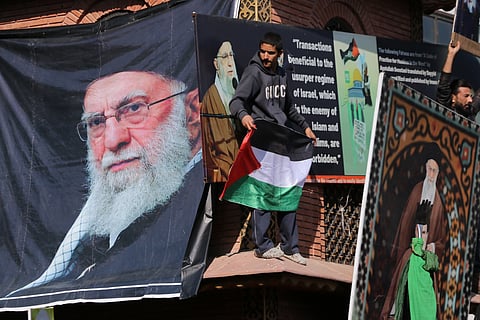


SRINAGAR: Barricades have lined the streets around Lal Chowk since Sunday, March 1, when the area was sealed following a day of fierce protests after Iran’s Supreme Leader and the spiritual leaders of the Shias, Ayatollah Ali Khamenei, was killed in the US-Israel attack in Iran.
Heavy security blanketed Kashmir's districts on Friday in the run-up to Friday prayers during the month of Ramazan.
The restrictions could not entirely hold back the tide. After Friday prayers, groups of people poured onto the streets in Chattabal, Budgam and Magam, raising anti-US and anti-Israel slogans, while chants echoed inside several Imambaras across the valley.
In a fresh clampdown after the protests, police have registered seven cases under Section 13 of the Unlawful Activities (Prevention) Act (UAPA) and provisions related to unlawful assembly and stone pelting. A report said, more than 120 people were detained. Police confirmed that 44 of them were formally arrested. The rest were precautionary detentions.
Siege Around Lal Chowk
The impact of the restrictions is still visible across Srinagar's commercial centre, where shops around Lal Chowk remain largely closed, days after the protests began.
Ghulam Nabi, a dry fruit seller with a small shop near Lal Chowk, said the market had stayed largely shut since Sunday. "Our shops have remained closed since the day the protests started," he said.
"Normally Lal Chowk is one of the busiest markets in Srinagar, but these days the streets are mostly empty because of barricades and heavy security presence. However, there was a bit of life back on Thursday."
The empty Lal Chowk area stands in contrast to what it looked like on March 1.
When People Poured Out
Showkat Ali was in tears when he left his home that morning. The 25-year-old Srinagar graduate had heard the news of Khamenei’s assassination after Sunday prayers. Like many others in the old city, he could not stay inside.
He joined a mourning procession that wound its way through the narrow lanes of Aalamgari Bazar, moving toward Lal Chowk. It was Sunday, and the city's markets had not yet opened, but the square was already beginning to fill.
"When we heard the news, many of us came out of our homes in tears," he said, standing near the clock tower as the crowd around him continued to swell.
"For many people here, this loss feels deeply personal. He was a spiritual guide for millions, and today the entire Muslim ummah is grieving. We gathered at Lal Chowk to express our grief and anger peacefully, within the law, against those we believe were responsible and those who support them."
Within hours, what had begun as scattered processions through the old city's narrow lanes had become something far larger. Men, women and children poured in from across Srinagar and nearby districts including Budgam, converging in Lal Chowk.
Some mourners climbed the clock tower, draping it with large portraits of Ayatollah Ali Khamenei and unfurling the flags of Iran and Palestine over the square below.
Mourners raised a series of slogans, invoking themes of resistance and religious symbolism. Among the chants heard were “Khamenei tere khoon se, inquilab aayega” (From your blood, Khamenei, a revolution will come), and “Tum kitne Hosseini maroge… har ghar se Hosseini niklega” (How many followers of Imam Hussain will you kill… a Hosseini will rise from every home). Others chanted “Allahu Akbar, Khamenei rehbar” (God is great, Khamenei is the leader), as crowds swelled and marched through parts of Srinagar and nearby areas.
Irfan Ahmad, a mourner who joined the protest at Lal Chowk from Saida Kadal, said thousands of people had gathered around the square and that the protests remained peaceful throughout the day.
By mid-morning, Lal Chowk had become the centre of the largest public protest seen in the Valley since the abrogation of Article 370 in 2019.
The Silence Since 2019
Since the revocation of the region’s special status in August 2019, tighter security controls, frequent detentions, and the use of laws such as the Public Safety Act (PSA) have created a climate in which many residents say they are hesitant to speak out openly on political issues.
Fear of arrests or legal action often discourages people from expressing themselves publicly, many say, even as emotions and political opinions remain strong.
“People still have opinions, but there is always the fear of consequences,” said Arif Ahmad, a Political Science student from Budgam. “The Public Safety Act and other laws are constantly in people’s minds. That is why many Kashmiris do not speak directly for themselves in public spaces anymore.”
Solidarity with Middle East
Few political protests witnessed since 2019 have not involved local issues but the distant politics of the Middle East.
In 2024 and 2025, demonstrations over Israel’s war in Gaza and US strikes on Iran’s nuclear installations were largely organised by Shia groups but drew participation from people across communities.
The demonstrations reveal how geopolitical events in distant parts of the Muslim world often resonate with singular intensity in Kashmir. Kashmiri Muslims, particularly Shias, have a much stronger and historic connection with Iran.
But observers believe the protests are not solely an expression of grief over the killing of the Iranian leader. They are also seen as an outlet for a deeper, simmering anger. Years of tightening restrictions, a pervasive climate of fear, and a sense of political suffocation have left many residents with little space to vent their frustrations. The moment events in the wider Muslim world ignite public emotion, that pent-up anger finds a channel, experts say.
Blend of Personal and Political
Such reactions are not new. For decades, the Valley has witnessed waves of protest sparked by developments involving Muslims in distant corners of the world, offering a sneak peek into Kashmir's complex sense of identity, where local grievance and global solidarity have long been intertwined.
Such outpourings offer a cautionary tale.
Sheikh Showkat Hussain, a Kashmiri political analyst and prominent scholar of human rights and international law, told the Kashmir Times that Kashmir has historically witnessed periods of relative dormancy that were later disrupted by triggering events, reviving public agitation.
“For decades, Kashmir experienced several phases of dormancy which were later shattered by certain developments, restoring the normal pattern of agitation and struggle,” he said.
“We saw this between 1954 and 1963, when the disappearance of the holy relic from Hazratbal became a major provocation. Again, between 1975 and 1986, there was a similar period of relative quiet, which was eventually broken by electoral fraud that triggered the insurgency.”
He added that the phases of dormancy were often misinterpreted by authorities. “Unfortunately, instead of using these periods for peace building, they were mistaken for permanent peace,” Hussain said.
“This time, the killing of Ayatollah Ali Khamenei appears to have triggered a similar phenomenon, where a period of dormancy that was presumed to be peace has been suddenly shattered,” he added.
Aftermath of Sunday Protests
The outrage that poured out on the streets last Sunday after news of Khamenei’s killing was perhaps not preempted by the authorities. The protests went on, by and large, peacefully throughout the day.
However, by the evening, police began barricading the Lal Chowk – the nerve centre of the capital city that has been a historic site of grievance and protest, and which the present government has been showcasing as a space of ‘normalcy’ and ‘integration’.
Lal Chowk was barricaded with tin sheets and concertina wire to block access to the area by the morning of March 2,” said Showkat Ahmad. “It was the first time in the past six years that such barricades were placed there to prevent people from gathering.”
He said the restrictions were not limited to Lal Chowk. “Roads in several other areas were also blocked with concertina wire to stop protests.”
Aamir Hussain from the old city, who was at Lal Chowk protest last Sunday, said the restrictions were particularly painful as “we were grieving. It was a disrespect to our feelings.”
“If there was no violence on Sunday when we gathered peacefully, why did authorities feel the need to barricade the city afterwards?”
“It appeared the authorities were trying to clamp down on the protests before they could grow larger,” Aafaq Bashir said.
Authorities also ordered the closure of educational institutions across the Kashmir Valley, initially for two days, and later extended till March 7.
Barricades and Lathicharge
Protests continued across the Valley in different parts of the Valley in the following days, witnessing clashes with police and security forces in some places.
The first flashpoint came in Zadibal on March 2, where Khursheed Ahmad, a local mourner, alleged that a police officer confronted protesters who were holding a portrait of Ayatollah Ali Khamenei. The officer snatched the poster from a mourner and tore it apart in front of the crowd, an act many saw as deliberately provocative.
"We demanded that the authorities bring the officer forward and apologise to the mourners," Ahmad said. "Instead, tear gas shells were fired, and after that, the stone-pelting began."
Clashes spread quickly. According to various reports, at least 14 people including six security personnel were injured on the second day of protests, while other accounts put the figure at 20 injured, including 16 policemen, in clashes in Bandipora's Sumbal area in north Kashmir.
Police also detained several protesters, though officials did not disclose the total number of arrests.
A lawyer practising at the Jammu and Kashmir High Court, who requested anonymity, said authorities had invoked stringent laws against some detainees. "In some cases, they alleged that protesters raised pro-militant and anti-India slogans," he said.
Officials, however, said that the teargassing and lathicharge was in retaliation to stone pelting and rioting.
Kashmir Zone Police issued an appeal on X, acknowledging citizens' right to peaceful expression while warning that "incidents of rioting, stone-pelting, clashes and disruption of public order are not acceptable." The statement added that police would take "strict legal action against instigators and miscreants involved in unlawful activities."
Women Protestors not Spared
The unrest deepened further after videos emerged showing women being beaten and tear gas being lobbed on mourners.
Protests spread to Aalamgari Bazar, Jehangir Chowk, Bemina, Shalteng and Gund Hassibhat in Srinagar, as well as Budgam and Pattan. One mourner shared a video with Kashmir Times purportedly filmed in the Shalimar area, in which security personnel could be seen pushing a young woman with a baton against her chest as she stood outside her home.
The video’s authenticity could not be verified.
A local Shia cleric said the footage had enraged many young protesters. "We stand against oppression and cannot bear the way our grieving mothers and sisters were treated," he said. "People who had come out only to mourn felt deeply hurt by what they saw."
Mourners were keen to push back against any characterisation of the protests as purely sectarian. "This was not only about the Shia community," said Bilal Ahmad, a university student who attended the demonstrations. "Many of our Sunni brothers also joined the protests."
Mohammad Iqbal, a resident from Budgam, noted that protests over international issues were not without precedent in the Valley. "When we were young, people would protest against America and Israel during events like Youm-e-Quds," he said. "At that time, authorities even provided security for such demonstrations."
Digital Restrictions
As protests continued, several Kashmiri news organisations reported that their Facebook and Instagram pages had been blocked for users inside India.
Meta later displayed an automated notice stating that access had been restricted pursuant to a government request under Section 79(3)(b) of the Information Technology Act, 2000. Kashmir Life, which has around 1.8 million Facebook followers, said it became aware of the block when readers began reporting they could no longer access its page from around 4:30 pm on Monday.
The outlet said it had written to Meta and authorities seeking clarification on the grounds, scope and duration of the restriction.
National Conference MP Aga Syed Ruhullah Mehdi wrote on X that his own Facebook account had also been suspended and that his security detail had been withdrawn or downgraded after he criticised the police crackdown.
"Some fools in J&K Police and administration think that by withdrawing or downgrading my security detail and suspending my Facebook account will stop me from calling out their atrocities," he wrote. "It is laughable."
Former chief minister Mehbooba Mufti also condemned the media restrictions, calling on authorities to uphold press freedom.
On Tuesday (March 3), Jammu and Kashmir Police registered FIRs against Ruhullah Mehdi and former Srinagar mayor Junaid Azim Mattu, accusing both of circulating "false, fabricated and misleading content" on social media with the intent to disturb public order and incite unlawful activities. The cases under FIR No. 02/2026 and FIR No. 03/2026 were registered at the Cyber Police Station in Srinagar under sections of the Bharatiya Nyaya Sanhita.
Security Beef-up on Friday
Despite enhanced security measures and restrictions ahead of Friday (March 7) prayers across Kashmir, groups of people took to the streets after Friday prayers in areas including Chattabal, Budgam and Magam, raising anti-US and anti-Israel slogans.
"A large number of people were already gathered in Magam for Friday prayers, and emotions were high," said Ghulam Abbas, a mourner from Magam. "Even with restrictions in place, people felt they had to express their grief and solidarity. Many raised slogans inside the Imambaras, while others came out onto the streets after the prayers."
The scale of protests had reduced after Tuesday as restrictions tightened and detentions increased. "After tear gas shelling and arrests, people became more cautious," said a resident who requested not to be named.
"There were smaller protests in some Srinagar neighbourhoods, while demonstrations continued in parts of Budgam and other Shia-dominated areas," he said.
In a video message posted on X, Mirwaiz Umar Farooq, dressed in black and wearing a small Iranian badge, said he had been placed under house arrest and barred from delivering his Friday sermon at Jamia Masjid Srinagar. The lanes leading to the historic mosque had been barricaded.
Farooq said the grief in Kashmir went beyond the restrictions, rooted also in the killing of Ayatollah Ali Khamenei and the escalating conflict in West Asia. He added that condemnation and solidarity had been expressed across Jammu and Kashmir, cutting across sectarian and regional lines.
Uneasy Calm
The streets in Kashmir are quieter than last Sunday and Monday (March 1 and 2), which witnessed clashes with police and security forces in some places. However, protests continue in some pockets. In the rest of the Valley, the calm is uneasy.
As Arif Ahmad says, “People may go back indoors because of restrictions and fear. But the grief and anger people feel will not disappear so easily. Even if the streets become silent again, the feelings in our hearts will remain.”
(The identity of the reporter has been withheld for fear of reappraisal and safety reasons)
Have you liked the news article?
Support us now:
https://www.gofundme.com/manage/jammu-kashmirs-sole-independent-voice-under-threat