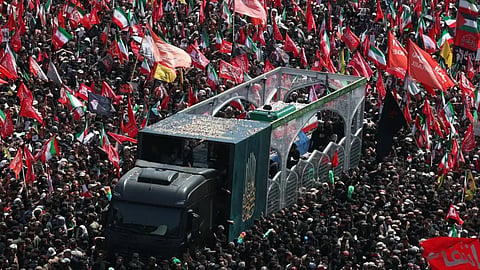


The funeral of Ayatollah Ali Khamenei was much more than just a formal farewell to a Supreme Leader of Iran. It was also a master-class in soft diplomacy, a strategic re-calibration of Iran's position on the global stage, and a complex geopolitical chess move. The Islamic Republic wanted to send a clear message that the "Axis of Resistance" remains a formidable and unyielding force despite the aggressive stances of the United States and Israel by inviting the world to witness the passing of its clerical helmsman.
Power is rarely demonstrated solely through the barrel of a gun in the intricate and perilous landscape of West Asian geopolitics. It is frequently whispered in diplomatic corridors, woven into religious symbolism, and displayed through statecraft's meticulous choreography.
Globalising the Mourning
It was a brilliant stroke of subversive diplomacy to invite a wide range of world leaders, including the United Nations. The Islamic Republic chose a policy of inclusion in a region frequently marked by sectarian division and hostility, effectively utilising the funeral as a platform for "funeral diplomacy." Tehran sought to break out of its diplomatic isolation by opening its doors to the international community, presenting a face of legitimacy and stability at a time of profound change.
Despite their ideological opposition to Iran's clerics, it was a calculated risk meant to force foreign capitals to confront Iran's power. The global presence at such an event indicates the necessity of maintaining open channels of communication for the United Nations, which frequently struggles with the dichotomy of Tehran's internal policies and its external influence. It reinforced the narrative that the Islamic Republic is an essential player in solving the world's crises, from the straits of Hormuz to the plains of Syria, and, thus, served as a tangible indicator of Iran's "relevance."
The Message to the Global South
The consolidation of Iran's leadership position within the Global South was perhaps the most significant political dividend. Iran is now a central anchor in a new, multipolar world order, and the presence of delegations from non-aligned nations as well as emerging powers highlighted a subtle but potent political reality. The funeral services became a place where anti-hegemonic forces came together, proving that the so-called Western consensus has flaws that Tehran can take advantage of. The funeral provided a potent counterargument to the narrative of American and Israeli military supremacy in this setting.
Secondly, Tehran was able to shift the conversation away from its adversaries' failed military strategies — air strikes, cyberattacks, assassinations — and towards its own narrative of resilience and continuity. It conveyed an unbroken Islamic Republic in the face of US-Israel's military might.
The Iraq Connection: The Axis of the Shia Crescent
The funeral strengthened the geopolitical and theological ties of the "Shia Crescent" far beyond Iran's borders. It was not only a deliberate act of political and religious consolidation to decide to extend the funeral rites to Iraq, which culminated in the massive movement of the crowd across the border. It is a clear example of the beneficial influence that existed between the religious centers in Qom and the holy cities of Najaf and Karbala. Tehran wanted to strengthen the historical connection between Grand Ayatollah Ali al-Sistani and Ayatollah Khamenei by moving the funeral to Iraq and then back to Mashhad for final burial.
The public spectacle of the funeral transcended these theological nuances, despite their divergent visions of clerical involvement in governance: one championing the Velayat-e Faqih (Guardianship of the Jurist) and the other adhering to the quietist tradition. It was about power projection and the consolidation of the "Shia constituency" as a unified geopolitical bloc.
Additionally, this action served to combat Iran's "policy of fragmental morality" and internal discord. By mobilising millions in Iraq and tying the Iranian leadership to Shia Islam's holiest sites, Tehran was sending a clear message to Iranians who support secularism or monarchy —those who might be tempted to "revolt against the clergy" in the style of the Pahlavi dynasty at Tel Aviv's behest. It established Iran's legitimacy as the ultimate safeguard of Shia identity against foreign interference.
The Pakistan Equation
A layer of strategic depth was added to the proceedings by the presence of Pakistan's leadership, particularly Pakistan Prime Minister Shehbaz Sharif and the Army Chief Asim Muneer. In terms of regional stability, their participation was a clear indication that Pakistan and Iran are currently on the same page. Iran's claim that it is a responsible regional actor was strengthened by Pakistan's presence, which served as a bridge-builder because of its unique position as a military power with ties to both the Gulf and the West.
Given Pakistan's role as a mediator, Iran was able to convey its willingness to engage on its own terms. Additionally, it subtly positioned Islamabad as a counterweight to the Gulf's reliance on Washington, implying that the region's security architecture is shifting away from the conventional model that is centered on the United States.
Quranic Verses and Multifaceted Messaging
The Iranian state apparatus used the recitation of various Quranic verses tailored to various international delegations in a display of novel diplomacy. This was a sophisticated form of nonverbal political communication, not just religious observance. Verses promoting peace and coexistence have been chosen for the Western attendees, while those promoting justice and anti-imperialism have been selected for the Eastern delegations. Verses promoting unity and the binding ties of kinship and faith have been chosen for the Arab delegations.
This revealed Iranian diplomacy's ability to adapt its message to the listener while maintaining a consistent underlying narrative. Tehran was able to play both the mediator and resistance roles at the same time, extending handshakes to some and quietly reiterating its ideological stance to others.
The Saudi Paradox
The Saudi delegation's attendance at the funeral exposed just how complicated and unfinished the China-brokered 2023 détente still is. Though the deal suggested tensions had cooled, the funeral made clear that old "misunderstandings" and rivalries remain deeply entrenched.
Riyadh's attendance was a pragmatic necessity: recognition that it can no longer ignore its powerful neighbour to the east, and a performance of sovereign diplomacy in its own right.
For Tehran, the Saudi presence was a victory lap — proof that even its oldest rival must show it respect. By showcasing "strategic patience" and its knack for reconciling with old adversaries, Iran cast itself as the region's senior statesman. Yet rivalry persists beneath the softened rhetoric: Iran remains a power to be consulted, not challenged. The real question now is whether this thaw can extend to harder issues, like Yemen.
Internal Consolidation
The policy of fragmental morality was the goal of the event at home. The state aimed to marginalise those who had been encouraged by previous protests, which the regime frequently linked to agitation from abroad, by projecting an image of a united nation mourning. Even though the coercive mechanism of state-sponsored grief was used, the funeral was a time of national unity when the political contract between the people and the clergy was ostensibly renewed. It sent a powerful message to those who want to go back to the Pahlavi era, indicating that the clergy will not give up its power.
Iran's Enduring Game
Ayatollah Ali Khamenei's funeral was not just the end but also the beginning. Utilising traditional religious ceremonies to achieve contemporary geopolitical goals was a demonstration of Iran's remarkable adaptability and evolution. By combining hard political messaging with soft diplomacy and reaffirming its position as a powerful player on the global chessboard, Iran demonstrated that its power derives not only from its nuclear ambitions or military proxies, but also from its ideological influence and strategic connectivity across the Global South.
The funeral demonstrated the resilience of a system that views itself not only as a state but also as an idea—and history demonstrates that ideas are notoriously difficult to eradicate.
Have you liked the news article?
Support us now:
https://www.gofundme.com/manage/jammu-kashmirs-sole-independent-voice-under-threat