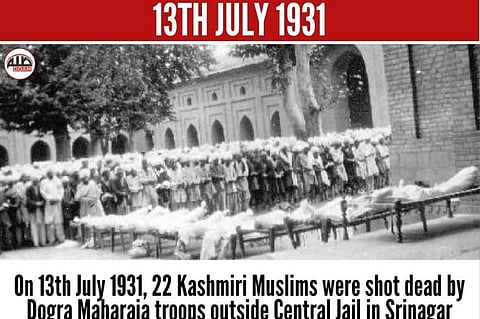


My recent article on the events of July 13, 1931, has generated considerable discussion. That is welcome. History advances not through silence but through informed debate. Some readers have questioned the authenticity of the Azan narrative, relying principally on the Dalal Commission Report to dismiss it. Such an approach overlooks both the limitations of that report and the broader principles of historical inquiry.
Limitations of Official probe
The Dalal Commission cannot be treated as the final or infallible authority on the events of July 13. It was a government-appointed inquiry constituted by the very regime whose conduct had come under scrutiny. Institutional reports investigating the actions of the authorities that appointed them must always be read critically and alongside other contemporary evidence.
More importantly, the Commission could scarcely have acknowledged the Azan narrative. To have done so would have amounted to an admission that the Dogra administration had opened fire on Muslims while they were engaged in an act of worship. Such an acknowledgement would not merely have condemned the conduct of individual officials; it would have amounted to an indictment of the regime itself.
The controversy cannot be understood without appreciating the historical place of the Azan in Kashmir. The non-Muslim regimes that ruled Kashmir from 1819 to 1947 appear to have displayed a persistent hostility towards the public expression of Islamic worship, particularly the Azan and large congregational prayers in mosques. Whether under the Sikh rulers or later under the Dogra administration, restrictions on the call to prayer and the closure of mosques repeatedly surfaced as major Muslim grievances. The Azan was viewed not merely as a religious proclamation but, increasingly, as an assertion of a community's identity and dignity. Consequently, it became a recurring point of friction between the rulers and the ruled.
Against this historical backdrop, any official acknowledgement that police firing had interrupted the Azan would have carried profound implications. It would have been seen as official recognition that the State had used lethal force against Muslims at the very moment, they were preparing to fulfill one of their most sacred religious obligations.
The Commission's own handling of evidence illustrates its limitations. In the Nawab Bazar firing, it accepted the soldiers' plea that they had been attacked and were, therefore, compelled to open fire. Yet when Mrs. Thakur Das, a Hindu midwife, testified that "the sepoys fired without cause," her testimony was discounted on the ground that she had personal grievances after being reverted from a Health Department post and hoped to improve her medical practice in a predominantly Muslim locality. Such reasoning inevitably raises questions about the standards by which evidence was assessed.
Historical reconstruction, however, does not rest upon a single commission, a single witness or a single document. It emerges from the careful evaluation of all available evidence.
Testimonies and Oral Record
The broad historical consensus remains that the firing occurred at the time of the Zuhr prayer, when the Azan was being called and the congregation was preparing for prayer. It was precisely this religious dimension that transformed the incident from a political confrontation into one of the defining moments in Kashmir's collective memory.
Sheikh Mohammad Abdullah records this sequence in Aatish-e-Chinar (p. 89). Critics point out that he was not physically present outside the Central Jail when the firing occurred. That observation is correct but historically inconclusive. Immediately after the firing, Sheikh Abdullah rushed to the Jamia Masjid where the bodies of the martyrs had been brought. There, he received detailed accounts directly from numerous eyewitnesses who had witnessed the entire episode. His narrative was, therefore, based on testimony obtained immediately from primary witnesses. It cannot be dismissed as mere hearsay.
Equally significant is the testimony of the brother of one of the martyrs, who accompanied his brother to the jail and survived the firing. His account corroborates the essential sequence of events. Added to this is the remarkably consistent oral tradition that has preserved the memory of the episode across generations. Historians cannot ignore such converging evidence merely because an official inquiry chose not to record every detail.
The most moving element of the narrative is, of course, the tradition that twenty-two men successively stepped forward to complete the Azan after each caller fell to police bullets. Historians have observed that the number twenty-two corresponds to the number of those killed, symbolically linking each martyr with an act of worship. The image of one man falling and another immediately taking his place, fully conscious of the fatal consequences, evokes the moral universe of Karbala. It transformed political protest into a saga of religious martyrdom and explains the narrative's enduring emotional and cultural power.
Here, however, historical method requires an important distinction.
From a historian's standpoint, the essential facts are firmly supported. It was the time of the Zuhr prayer. The congregation was preparing for worship. The Azan was being called. Police firing interrupted that act of worship, killing twenty-two Muslims. These facts are supported by multiple sources and explain why the incident generated such profound public outrage.
What remains unverified by independent eyewitness depositions is the precise sequence of twenty-two individuals successively completing one uninterrupted Azan. In historiographical terms, this belongs to the realm of martyrology. That does not make it fiction. Rather, it represents historical memory shaped over time to express a deeper truth about sacrifice, faith and collective suffering.
Misreading Makhdoomi’s Account
Some readers have relied upon the writings of Afzal Makhdoomi to reject the Azan narrative altogether. Such a reading is selective. Afzal Makhdoomi in his book, Kashmir ki Tehrik Azadi, nowhere denies that the Azan was called. What he records is that Maulana Mohammad Abdullah asked the thousands assembled outside the Central Jail to offer the Zuhr prayer, whereupon the congregation immediately began preparing for prayer before the police opened fire.
Every student of Islam knows that a congregational Zuhr prayer, particularly before thousands assembled in an open space, is ordinarily preceded by the Azan. Makhdoomi's narrative is, therefore, entirely consistent with the established tradition. His silence regarding the call itself cannot reasonably be interpreted as evidence against it.
More significantly, Makhdoomi's own narrative contains an internal inconsistency that is often overlooked by those who cite him selectively. On page 52, he records that Shaheed Abdul Khaliq Shora gave the Azan. Thus, Makhdoomi himself associates Abdul Khaliq Shora with the Azan tradition. It is, therefore, methodologically unsound to rely upon his silence elsewhere as proof that no Azan was called on July 13. A historian must read a source as a whole. Selective quotation is not historical method.
Equally revealing is another omission in Makhdoomi's account. He writes that stones began to be thrown but does not identify who threw the first stone or under what circumstances. Did the crowd begin the stone-pelting? Did the police provoke it? Was it a spontaneous reaction to official action? He does not say.
Silence, Gaps are not Evidence
That omission lies at the heart of the controversy. Yet no responsible historian fills such gaps with assumptions. Silence is not evidence, and ambiguity cannot be transformed into certainty because it serves a preferred narrative.
Historical method requires precisely the opposite. It demands that every available source be critically evaluated, its strengths and limitations recognised, and conclusions drawn only after comparing independent testimony. The omission of one detail by one witness cannot invalidate the positive testimony of others.
The Dalal Commission itself must also be viewed in context. It is often forgotten that its report was vigorously challenged by the leadership of the movement. Indeed, differences among the members prevented the report from being formally submitted to the Government in the normal manner. That fact alone demonstrates that it was not a unanimous or uncontested document.
Public reaction was equally revealing. A massive meeting was organised in Jammu to protest the report. Copies were publicly burnt, and the agitation compelled the Government to appoint another inquiry under Middleton. Contemporary society itself, therefore, did not regard the Dalal Commission as the final word on the tragedy.
Even the Dalal Committee refers only to stray communal incidents at Maharaj Gunj and Vicharnag, reportedly triggered after some Khatris jeered at mourners near the Primary Health Centre at Maharaj Gunj. This falls far short of the sweeping allegations of organised communal violence that are frequently advanced today without supporting documentation.
Historiography demands verifiable and credible evidence. Assertions, however emphatic, are no substitute for documentation. Lengthy responses filled with sarcasm or personal attacks cannot replace evidence. Those who make sweeping claims must produce reliable contemporary sources to support them.
One Detail Can’t Obscure the Larger Tragedy
Nor should debates over one detail obscure the enormity of the tragedy itself. On July 13, 1931, twenty-two unarmed Kashmiri Muslims lost their lives in firing ordered by Raizada Trilok Chand outside the Central Jail. Within days, another firing took place at Anantnag under Magistrate Mattoo on people dispersing peacefully after protest. The wave of repression did not extinguish resistance; it deepened it.
Indeed, the aftermath of July 13 marks one of the most remarkable chapters in Kashmir's history. What began outside the Central Jail in Srinagar did not remain confined to the capital. The spirit of grief, protest and defiance spread rapidly across the Valley.
The call for justice travelled from city to countryside, from mosque to mosque, and from village to village. People from Shopian, Anantnag, Baramulla and other parts of Kashmir came forward with extraordinary courage, prepared to endure imprisonment, repression and even death. Martyrdom was no longer confined to Srinagar; it became the shared experience of Kashmir. The movement had acquired a moral force that bullets could not suppress.
History is not served by selective reading. It demands that official reports, autobiographies, eyewitness testimony, oral tradition and historical context be examined together. Each source contributes something; none alone possesses the whole truth.
The Azan narrative should, therefore, neither be accepted uncritically nor rejected dogmatically. Its essential historical core is supported by multiple strands of evidence. Its more dramatic elements belong to the tradition of martyrology through which societies preserve memories of extraordinary sacrifice. Such traditions are found across civilizations. They are not fabricated history; they are historical memory shaped by the moral imagination of a people.
The tragedy of July 13 deserves neither romanticisation nor trivialisation. It deserves honesty, balance and intellectual integrity. The men who fell that day did more than lose their lives. Their sacrifice awakened a people. It transformed scattered grievances into a mass movement, turned mourning into resistance, and gave Kashmir a shared political consciousness that would shape its history for decades to come.
Whether one approaches the event as a historian or as a student of collective memory, one truth remains beyond dispute: July 13, 1931, became the watershed from which modern Kashmir drew both its political awakening and its enduring vocabulary of sacrifice.
Have you liked the news article?
Support us now:
https://www.gofundme.com/manage/jammu-kashmirs-sole-independent-voice-under-threat