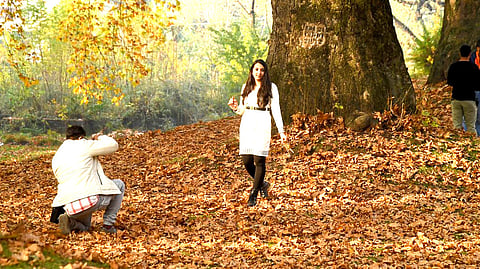


Kashmir has never suffered from a shortage of beauty. Its mountains, lakes, rivers, forests, meadows, snowfields, gardens, architecture, crafts, cuisine and cultural traditions give it a natural advantage enjoyed by very few destinations in the world.
Yet whenever we discuss tourism in Kashmir, the conversation almost invariably begins and ends with one number: How many tourists came?
That is the wrong question.
We should instead ask how much economic value each visitor created, how long the visitor stayed, how much was spent locally, how many Kashmiris benefited and what ecological cost the visit imposed.
The distinction is fundamental.
A million tourists who stay briefly, travel on package tours, spend little locally and crowd a handful of destinations may generate less lasting economic value than a fraction of that number staying for a week, using local guides, eating Kashmiri food, buying local products and participating in adventure, cultural or wellness activities.
The objective of what I call the Ultimate Oasis should therefore not be mass tourism. It should be high-value, sustainable tourism built around Kashmir's natural, cultural and human capital.
The rapid growth in tourist numbers demonstrates Kashmir's extraordinary attractiveness. But it also exposes the weakness of measuring success primarily through arrivals.
Official figures recorded approximately 2.35 crore tourist visits to Jammu and Kashmir in 2024, including around 65,000 foreign visitors. Different datasets produce different totals depending on whether they count the entire Union Territory, Kashmir division, pilgrimage traffic or tourist visits separately.
The precise number matters less than the underlying vulnerability.
Tourism can collapse after a security incident, climatic event, road closure or geopolitical crisis. The aftermath of the 2025 Pahalgam attack demonstrated how rapidly cancellations can empty hotels and undermine livelihoods.
Kashmir therefore needs a tourism model based on value rather than volume, resilience rather than dependence, and quality rather than congestion.
Fragile Valley
Kashmir is geographically constrained. Its mountain ecosystems, lakes, forests and wetlands are sensitive. Road capacity is limited, while water, sewage and waste-management systems are already under pressure.
Gulmarg illustrates the challenge. A carrying-capacity study cited in government tourism planning material estimated its physical capacity at around 5,000 visitors a day, but placed its more realistic capacity at only about 1,000 when environmental and experiential constraints were considered.
This should change the way we plan tourism.
Before constructing another hotel or promoting another million arrivals, planners should ask: How much water can a destination supply? How much sewage and solid waste can it process? How much traffic can its roads absorb? How much construction can its landscape tolerate? And how many visitors can it accommodate without destroying the experience for which people came in the first place?
Every major destination needs a scientifically determined carrying-capacity ceiling.
Once that ceiling is reached, the solution cannot always be to build more. Visitors should instead be distributed to other destinations.
For decades, Kashmir has essentially marketed one circuit: Srinagar, Gulmarg, Pahalgam and Sonamarg.
This concentrates traffic, construction, investment and ecological pressure in a few locations while leaving much of the Valley outside the tourism economy.
Kashmir possesses hundreds of landscapes and communities capable of hosting visitors. But simply declaring new "tourist destinations" will not work. Each needs a distinctive economic identity.
One area could specialise in winter sports, another in trekking and mountaineering. Others could develop around wellness, heritage, birdwatching, biodiversity, rural tourism, Kashmiri cuisine, crafts, fishing or cultural immersion.
Kashmir must evolve from a collection of overcrowded tourist spots into a network of specialised destinations.
That also requires changing what we sell.
Mass tourism sells sightseeing. High-value tourism sells experiences.
A visitor should not simply be driven to Dal Lake, Gulmarg and Pahalgam, photographed at each location and returned to the airport.
Imagine instead a week combining a traditional houseboat stay, Kashmiri cuisine, a visit to an artisan's workshop, guided Himalayan walks, fly-fishing, skiing, cycling, birdwatching, Sufi heritage, orchard visits, farm-to-table meals and boutique heritage accommodation.
That creates much more than a hotel room-night. It creates an economic ecosystem around every visitor.
Seasonality is another weakness. Tourism remains concentrated in a few months, leaving hotels, taxis, restaurants, guides and workers facing intense demand during one period and underutilisation during another.
Every season must therefore acquire its own tourism identity.
Spring can offer gardens, blossoms, horticulture, food and photography. Summer can focus on trekking, lakes, fishing, cycling and high-altitude experiences. Autumn can combine harvests, orchards, cuisine, colours and cultural tourism. Winter can expand beyond Gulmarg into skiing, snow sports, wellness and specialised retreats.
The objective should be to transform Kashmir from a seasonal destination into a genuine four-season economy.
High-paying travellers do not necessarily seek large luxury hotels. Increasingly, they seek authenticity, reliability, privacy and exceptional experiences.
A well-designed eco-lodge overlooking a mountain landscape can command greater value than a conventional hotel. A restored traditional home offering outstanding Kashmiri cuisine may provide a more memorable experience than an international chain.
But authenticity cannot compensate for poor infrastructure.
Visitors still require reliable electricity, clean water, sewage treatment, scientific waste management, telecommunications, emergency medical facilities, trained guides, dependable transport and professional destination management.
Recent tourism consultations have identified shortcomings in smaller destinations, including inadequate master planning, accommodation, road access, waste and septage management, filtered water and trained tourism professionals.
Kashmir must therefore combine international standards with Kashmiri identity, rather than international architecture with Kashmiri scenery.
Luxury should not mean turning Kashmir into Dubai.
Keep Money in Kashmir
Perhaps the most important economic question is not how much tourists spend, but how much of that expenditure remains within Kashmir.
Suppose a visitor spends ₹100,000. If much of that goes to outside airlines, online booking platforms, external tour operators, hotel chains and imported products, the headline tourism revenue exaggerates the benefit to the local economy.
The goal should be to maximise what may be called the local retention ratio.
Hotels should procure locally. Restaurants should use Kashmiri produce. Tour operators should employ local guides. Farmers should supply hotels. Artisans should become part of itineraries. Horticulture should become a visitor experience as well as an export industry. Tourists should be encouraged to buy authentic crafts directly from producers.
Tourism then becomes a multiplier.
A rupee spent by a visitor passes from a hotel to a farmer, from a restaurant to a fisherman, from a tourist to an artisan, and from an adventure company to a local guide.
This is how tourism creates broad-based prosperity rather than merely impressive arrival statistics.
Tourism departments should consequently stop treating arrivals as their principal measure of performance.
A modern tourism dashboard should measure revenue per visitor, average length of stay, local expenditure, the percentage of spending retained within Kashmir, year-round hotel occupancy, local employment, procurement from local businesses, visitor satisfaction and repeat visits.
Environmental indicators should be equally important: waste generated per tourist, water consumption and the carbon footprint of tourism.
A destination receiving fewer tourists but earning substantially more from each visitor, creating more local jobs and protecting its environment should be regarded as more successful than one breaking footfall records while degrading its natural assets.
Such a transformation cannot be delivered by the Tourism Department alone.
Kashmir should consider a specialised Tourism Investment Corporation bringing together government, local entrepreneurs, diaspora capital and institutional investors. Its purpose should not be to finance more mass-market hotels, but boutique properties, eco-lodges, heritage homes, wellness resorts, adventure infrastructure, rural tourism, destination transport and waste-management systems.
The Kashmiri diaspora could contribute capital, expertise and access to international markets.
Major tourism zones also need integrated destination management. Tourism, environment, forests, transport, culture, horticulture, urban planning, water, sanitation, security, private enterprise and local communities cannot continue operating in separate silos.
A destination is an ecosystem. It must be managed as one.
Human capital is equally important. Kashmir's tradition of hospitality is a tremendous asset, but hospitality alone does not create a world-class tourism industry.
Young Kashmiris need professional training in hotel management, culinary arts, mountain guiding, skiing, adventure tourism, foreign languages, digital marketing, destination management, heritage interpretation, wellness and biodiversity management.
Training must be developed with the industry so that qualifications translate into jobs and entrepreneurship.
Tourism and Stability
There is also a reality no tourism strategy can ignore.
Tourism is exceptionally sensitive to perceptions of security and political stability. Visitors can cancel within hours. Investors can postpone decisions for years.
A sustainable tourism economy therefore requires confidence among visitors, investors and, most importantly, local communities.
The Ultimate Oasis cannot simply be a tourism marketing campaign. It has to form part of a broader vision involving peace, political stability, openness and regional connectivity.
Connectivity is central to that resilience. Kashmir needs dependable highways, improved rail services, competitive air links, efficient internal public transport and controlled vehicle access to ecologically fragile destinations.
No sophisticated tourism economy should remain overwhelmingly dependent on a single vulnerable transport artery.
Kashmir should never try to compete with mass destinations by becoming cheaper.
Its competitive advantage lies elsewhere: beauty, authenticity, culture, climate, hospitality, exclusivity and experience.
These are premium assets.
High-value tourism does not mean excluding ordinary travellers. Kashmir should remain accessible to families, pilgrims, students, backpackers and domestic visitors. But each segment requires a different product. Pilgrimage traffic should be managed as pilgrimage traffic. Backpackers need affordable facilities. Adventure travellers require professional safety standards. Premium visitors require specialised experiences. International tourists expect globally competitive services.
Trying to force every visitor into a single tourism model serves nobody.
The economic equation should instead be simple:
Fewer tourists × longer stays × higher spending × greater local retention × lower ecological cost = higher tourism value.
Tourism must also connect with Kashmir's wider economy. Horticulture can support orchard tourism and gastronomy. Handicrafts can feed cultural tourism and premium retail. Fisheries can support fly-fishing and cuisine. Mountains can sustain adventure and winter tourism. Agriculture can generate rural and farm-to-table experiences. Culture can support heritage and spiritual tourism.
The result would be an interconnected economy rather than an isolated tourism sector.
One day, Kashmir should stop celebrating tourism success by announcing that 20 million or 30 million people visited.
Success should mean being able to say that tourism created thousands of quality jobs, sustained local enterprises, lengthened visitor stays, increased local incomes and preserved the ecological integrity of the mountains, lakes, forests and meadows on which the entire industry depends.
Kashmir does not need to become one of the world's busiest destinations.
It should aspire to become one of the world's most valuable, distinctive and sustainable destinations.
The objective is not to fill Kashmir with tourists.
The objective is to make every visitor valuable to Kashmir, while ensuring that Kashmir remains valuable to every visitor.
Have you liked the news article?
Support us now:
https://www.gofundme.com/manage/jammu-kashmirs-sole-independent-voice-under-threat