

The auction of two limestone blocks in Anantnag should not be viewed merely as another government exercise in mineral allocation. It raises a much larger question about Kashmir’s natural resources and, more importantly, about the kind of economy we want to build around them.
Will Kashmir simply extract its limestone and send it elsewhere, or will it use this enormous resource to create industries, employment and wealth within the region?
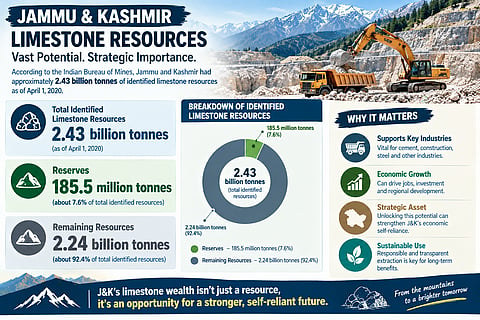
According to the Indian Bureau of Mines, Jammu and Kashmir had approximately 2.43 billion tonnes of identified limestone resources as of April 1, 2020. Of this, around 185.5 million tonnes were classified as reserves and approximately 2.24 billion tonnes as remaining resources.
The distinction is important because the entire 2.43 billion tonnes cannot be regarded as immediately mineable, but the sheer scale of the resource nevertheless points to an industrial opportunity that deserves serious attention.
The two blocks now auctioned, Koot-Kapran and Wantrag in Dooru, Anantnag, contain approximately 4.75 million tonnes and 10.853 million tonnes respectively, or around 15.6 million tonnes combined. In November 2025, seven limestone blocks in Anantnag, Rajouri and Poonch were put up for auction, containing an estimated 57.8 million tonnes. Another 12 limestone blocks were offered in a second tranche in May 2026.
These auctions, therefore, involve only a fraction of the much larger limestone resource available in Jammu and Kashmir. The issue before us is not whether Kashmir possesses sufficient limestone to sustain industrial development, but what kind of industrial economy can be built around it.
Opportunity We Saw Four Decades Ago
Kashmir has known about the potential of its limestone for decades. When our family diversified from trading into industry in the 1980s, we established a polypropylene woven-sack factory, a silk-processing unit and subsequently entered marble processing. At the same time, we explored whether locally available limestone and sand could be used to manufacture modern building materials.
One proposal we examined involved producing lightweight building blocks similar to Ytong-type autoclaved aerated concrete products as an alternative to conventional clay bricks. There was an environmental as well as an industrial logic behind the idea.
Traditional clay bricks consume agricultural soil and, in a region where cultivable land is both limited and valuable, replacing at least part of that demand with products manufactured from locally available limestone and sand could create industry while also reducing pressure on agricultural land.
We had access to geological expertise and were told that Kashmir possessed limestone of very high quality. I also recall a senior Commissioner in the Department of Geology and Mining telling us that, with suitable processing, the mineral could have applications well beyond conventional cement manufacture. He referred, among other things, to its possible use in products such as polythene, although the technology and economics at that time did not make such applications commercially viable.
That recollection should not be misunderstood as suggesting that limestone can simply be converted into polyethylene. The relevance of those discussions was that even four decades ago, geological experts were encouraging us to look beyond the conventional use of limestone and examine its potential as an input for a wider range of manufactured products.
Technology, markets and manufacturing processes have changed enormously since then. What was technically difficult or commercially unviable in the 1980s may deserve a fresh examination today.
Limestone Much More Than Cement
Whenever limestone is discussed in Kashmir, the conversation invariably turns to cement. This is understandable because cement manufacture is one of the world's largest consumers of limestone, but limiting our thinking to cement would mean overlooking a substantial part of the mineral's economic potential.
Depending upon its chemical composition and purity, limestone can form the basis of several industries. Apart from cement and clinker, it can be processed into quicklime and hydrated lime, calcium carbonate, ground calcium carbonate and specialised precipitated calcium carbonate. These materials in turn have applications in calcium-based chemicals and in the manufacture of glass, paper-related products, paints and coatings, plastics and rubber, where mineral fillers are widely used.
Different grades of limestone can also serve as metallurgical fluxes, while other deposits may be suitable for agricultural lime and soil-conditioning products, water-treatment materials, construction aggregates and a wide range of building products. In other words, the economic possibilities extend from heavy industry and construction to chemicals, agriculture, environmental treatment and manufactured consumer and industrial products.
This does not mean that every limestone deposit in Kashmir can be used for every one of these purposes. Far from it. The suitability of a deposit depends upon its chemical composition, purity, calcium and magnesium content and several other technical characteristics. A deposit suitable for cement manufacture may not necessarily be the best source for a specialised calcium-carbonate product, while higher-purity limestone may have uses that command considerably greater value than ordinary crushed stone.
That is precisely why the headline figure of 2.43 billion tonnes, impressive though it is, needs to be accompanied by a systematic programme of scientific classification and value assessment. It is no longer sufficient merely to establish how many tonnes of limestone Kashmir possesses. We need to know what kind of limestone lies in each major deposit, what its chemical characteristics are, and what is the highest-value product that can reasonably and sustainably be manufactured from it.
From Tonnes to Value
This distinction goes to the heart of the economic question. A billion tonnes of mineral lying underground is a geological fact; the wealth it generates depends upon what is done with it after extraction.
At the lowest end of the value chain, limestone can simply be quarried, crushed and transported. Processing it into cement, lime, calcium carbonate or other intermediate materials creates greater value. Using those processed materials as inputs for paper, paints, plastics, rubber, glass, chemicals and specialised construction products takes the economy further down the manufacturing chain.
The further Kashmir moves along this chain, the greater the potential for investment, skilled and unskilled employment, entrepreneurship, technological capability, ancillary businesses and eventually exports. This is why the auction of a mining block should not be regarded as the completion of mineral policy. It should instead be regarded as the starting point of a much broader industrial policy.
This question has assumed particular importance following the regulatory change introduced in October 2025, when the Government of India classified limestone as a major mineral. The change was more than an alteration in terminology because it affected the regulatory framework under which these resources are allocated.
The present auctions are being conducted through the Ministry of Mines after the Jammu and Kashmir administration entrusted the auction of these blocks to the Union ministry. The J&K administration continues to have an important role under the mining framework, including in the grant and administration of leases and implementation of applicable regulations, but the allocation of these resources can no longer be viewed simply as a matter of local mineral administration.
It therefore becomes necessary to ask who will ultimately capture the economic value generated by Kashmir’s mineral wealth.
If limestone is extracted in Kashmir and transported elsewhere for processing, the region may receive auction revenue, royalties, taxes, wages and some associated business. The larger gains from processing, manufacturing, technology and downstream employment, however, may accrue elsewhere.
The outcome would be very different if the same resource supported lime plants, calcium-carbonate processing units, cement and construction-material factories, glass-related industries, paper and paint inputs, chemical units, specialised building-product manufacturers and research facilities within Jammu and Kashmir.
Such an industrial ecosystem would generate employment at several levels, create demand for engineers and technicians, support transport and other services, encourage local suppliers and provide opportunities for entrepreneurs. It could eventually allow Kashmir to export processed and manufactured products instead of remaining principally a supplier of raw minerals.
That is the fundamental difference between possessing a natural resource and building a resource-based industrial economy.
Mineral Development Strategy
A limestone resource measured in billions of tonnes cannot be approached merely one auction block at a time. Jammu and Kashmir needs a comprehensive mineral-development strategy linked directly to its industrial policy.
Every important limestone belt should be scientifically mapped, tested and classified so that policymakers and investors know which deposits are cement-grade, which contain high-calcium or chemical-grade limestone, which are suitable for lime and metallurgical applications, and which have the characteristics required for calcium-carbonate products, construction materials or other specialised uses.
There is already a scientific base upon which such an exercise can be built. J&K Minerals Limited has historically identified limestone in Anantnag, Pulwama and Baramulla as both cement-grade and chemical-grade, reporting calcium oxide content broadly in the 44 to 52 percent range. More recent geological investigations have also shown that deposits can differ significantly even within individual limestone belts.
Studies of the Gratabal-Saderkote belt, for instance, have demonstrated variations in chemical composition. Saderkote has characteristics consistent with cement-grade limestone, while higher magnesium content at Gratabal affects its suitability for cement under the relevant standards. Recent government testing at Saderkote has likewise indicated high calcium content.
Such variations reinforce the argument that limestone should not be valued merely by weight. Its economic worth depends upon chemistry, purity, location, accessibility, processing requirements and the potential end use of the material.
Once this scientific classification is available, an industrial strategy should identify the processing and manufacturing facilities that could realistically be developed around particular deposits. The objective should be to move progressively from resource extraction to processing, from processing to manufacturing and ultimately from manufacturing to higher-value exports.
Universities, geological institutions, engineers and research centres should be brought into this effort alongside entrepreneurs and investors. Instead of asking only how much limestone can be extracted, they should be examining what modern technology can manufacture from Kashmir’s different grades of limestone.
Auctions Alone, Not Prosperity
The government's stated objectives of attracting investment, creating employment, generating local business opportunities and adding value to mineral resources are important, but none of these outcomes will automatically follow from an auction.
They require a deliberate policy that combines scientific classification of deposits with local value addition wherever it is commercially and environmentally feasible. Such a policy should encourage downstream industries and participation by local entrepreneurs, while investing in skills and technology and ensuring strong environmental safeguards, mine restoration and transparent accounting of auction proceeds, royalties and other revenues.
Environmental considerations are particularly important in a region as ecologically fragile as Kashmir. Mineral development cannot be allowed to become an indiscriminate race to extract. The economic return from mining has to be weighed against the cost to forests, water systems, agricultural land, communities and the landscape, and restoration obligations should be built into mineral development from the beginning rather than treated as an afterthought.
Most importantly, the success of the policy should not be measured merely in tonnes extracted or the number of blocks auctioned. It should be measured by the value that Jammu and Kashmir is able to retain from every tonne that leaves the ground.
The figure of 2.43 billion tonnes should therefore not be treated simply as an impressive geological statistic. It represents a potential economic foundation, but geological wealth does not automatically translate into economic wealth. That transformation requires technology, capital, entrepreneurship, infrastructure, scientific knowledge and, above all, intelligent public policy.
The two Anantnag blocks contain around 15.6 million tonnes of limestone, which is substantial but still represents only a small part of the larger identified resource base. The bigger question, therefore, is not merely who has won these auctions, but what Kashmir will ultimately make from its limestone.
Will we remain principally suppliers of raw material, watching trucks carry mineral wealth elsewhere for processing and manufacturing? Or can limestone become the foundation of a diversified industrial economy producing cement and clinker, lime, calcium-carbonate products, chemicals, glass, construction materials and inputs for industries ranging from paper and paints to plastics and agriculture?
Four decades ago, some of us were already asking what could be manufactured from Kashmir’s limestone and sand rather than simply extracting these resources. Today, with a resource base measured in billions of tonnes and technology far more advanced than it was in the 1980s, that question has acquired much greater urgency.
The value of Kashmir’s limestone should ultimately not be measured only by what can be extracted from its mountains, but by the industries, employment and economic opportunities that Kashmir can build from every tonne extracted.
Have you liked the news article?
Support us now:
https://www.gofundme.com/manage/jammu-kashmirs-sole-independent-voice-under-threat