

The global order has undergone a tectonic shift under the shadow of simmering conflicts and shifting power centers. The Pentagon, once the unstoppable fortress of American military, economic, and ideological dominance, has fractured into a hexagon of poles that are at odds yet interconnected.
The world has adopted a polycentric multipolar architecture, a concept first proposed in Moscow and now burned into concrete. Russian foreign policy documents abandoned the term "multipolar world" in 2024 in favour of the more precise "polycentric multipolarity," making a distinction that is significant. Multipolarity implied distinct blocs with clear hierarchies. Polycentricity suggests something more fluid: overlapping memberships, multiple decision-making centres, no single conflict axis.
"The world is not a chessboard with two players," a Russian diplomat remarked. "It is a bazaar with a thousand stalls. The hegemon does not understand this. That is why he is losing,” he said.
This polycentric reality crystallised through a sequence of ruptures, leading to the untidy, violent rebirth of history, forged in the crucible of the Russia-Ukraine war of 2022, the escalation of the Palestine conflict in 2023, shattering Western moral authority. Notably, the International Commission of Jurists (ICJ) strongly condemns Israel's continued forcible displacement of Palestinians and its direct attacks against civilians in Internally Displaced Persons' (IDPs) camps and in humanitarian aid distribution sites in the Gaza Strip.
May 2025's 88-hour India-Pakistan war, triggered by the Pahalgam attack, and fought with BVR missiles and AI-assisted warfare before a ceasefire, claimed to be brokered by Trump, demonstrated how quickly bilateral rivalry could metastasise into multi-domain, multi-front engagement. Then came the US-Iran-Israel confrontations peaking on February 28, 2026, with American carrier groups and Israeli strikes targeting Iranian leadership, confirming that the India and Pakistan confrontation was not an aberration.
Fractures Remaking a World
Iran's response, however, froze the world. For the first time in the conflict, Tehran deployed Multiple Independently Targetable Re-entry Vehicles (MIRV) technology in a retaliatory salvo against Israeli strategic assets. Warheads split in mid-flight, striking three separate targets simultaneously, a capability previously monopolised by established nuclear powers. Israel's layered missile defences - Iron Dome, David's Sling, Arrow - were reduced to spectators.
"You cannot intercept a bus that turns into three taxis at the last second," a European defence attaché said.
The attack killed dozens, but more consequentially, it killed the myth of Western technological supremacy. Every regional power with a ballistic missile programme recalculated its deterrence calculus at that moment. As strategic analysts say, the threshold for existential retaliation had dropped through the floor.
In Asia, the Iran-Russia-China-Pakistan axis solidified as a counterweight to Western dominance. In parallel, a Saudi Arabia-Pakistan-Turkey-Qatar bloc emerged as a practical balance axis combining energy wealth and diplomatic leverage.
In the Middle East, the Gaza tragedy accelerated Gulf states’ pivot towards multipolarity. Addis Ababa and Nairobi are the new regional centres of Africa. South America’s leftist governments deepen ties with China and Russia. And in a symbolic lurch that shook the hemisphere, Venezuela’s president, a man placed by Washington’s failed ‘revolution’, now openly hostile to what he calls the “gringo rules-based order”, took the stage at the UN last September to declare: “They speak of a rules-based order. But whose rules? Whose order? It is a cage they built while we were bleeding.”
Meanwhile, Europe quietly decoupled from Washington's lead. In this hexagon of poles - Washington, Beijing, Moscow, New Delhi, Brussels, and a swing-state cluster anchored by Ankara, Riyadh, and Islamabad - no hegemon dictates.
India-Pakistan Hyphenation Lessons
The India-Pakistan war illuminated something deeper about polycentric conflict. For decades, military doctrine treated the subcontinent as a dyad: conventional war, then nuclear red lines. In May 2025, that binary dissolved. Within 48 hours the confrontation had become a multi-domain engagement where the front line was everywhere and nowhere. Islamabad fought New Delhi as though both were simultaneously neighbours and non-state actors.
The ceasefire, announced by Trump on Truth Social before either capital confirmed it, was less a demonstration of American power than a recognition of mutual annihilation looming. The deeper lesson was this: in a polycentric world, even bilateral enemies become hyphenated - their fates intertwined, their battlefields infinite, their only exit through negotiation.
It is out of this logic that Pakistan emerged as reluctant mediator. Pakistan's proposed sustainable ceasefire accord, first floated on February 28, 2026, remains stalled following Tehran's rejection on critical points - the Strait of Hormuz, the nuclear question, Lebanon and Palestine, the terms of any Israeli or American guarantee.
While the two-tier plan offers a pathway to reopen the Strait, Iran demands a permanent ceasefire and binding guarantees against regime-change efforts before relinquishing its economic leverage. With the UN paralysed and traditional mediators sidelined, Pakistan facilitated proximity talks and guaranteed air corridor protection for both delegations. Though a framework emerged, no final signature followed.
Yet the strategic architecture being constructed around those stalled talks is significant. Islamabad signed a Strategic Defence and Security Agreement with Riyadh last year; a similar pact with Ankara appears imminent. A Turkish parliamentarian from Erdogan's party has described Pakistan as a "border outpost" and a "red line", signaling political alignment beyond rhetoric.
With Washington's acquiescence, Pakistan has implemented six land trade corridors with Iran as of April 2026, utilising its role as a perceived facilitator of indirect US-Iran engagement to secure Iranian oil and gas through routes that bypass the Strait of Hormuz entirely. The strategic consequences extend regionally: India's $120 million Chabahar port, designed as a counterweight to Pakistan's Gwadar, loses much of its balancing utility as Tehran pivots towards Islamabad. New Delhi faces a significant long-term energy challenge it did not anticipate.
Goodbye Capitalism
Beneath the geopolitical architecture is a deeper problem: the world's exhaustion from war and the obvious decline of capitalism led by the United States. After decades of unipolar overreach, the United States finds its military stretched, its alliances fraying. The takeover of New York City by Mayor Zohran Mamdani, whose democratic socialist agenda signals capitalism's own epicentre turning inward, symbolises North America's internal fractures.
Venezuela's president has become the Global South's most audible speaker against the rules-based order: "They speak of rules when they invade, of order when they block our banks, of democracy when they fund our opposition."
His words carry weight not because they show that the talks in Islamabad proved that there is no longer a single arbitrator. Whether it is Venezuela resisting sanctions, Iran deploying MIRVs to balance Israeli technology, or Pakistan hosting peace talks that Washington could not force, the message is identical – no one commands the board.
SCO and BRICS nations now account for a larger share of global GDP than the G7. Pakistan’s mediator role shows how middle powers gain leverage by hosting negotiations rather than deferring to Washington. Africa's continental hubs attract Chinese infrastructure without ceding sovereignty. South America exports lithium on its own terms.
Hexagon of Hope
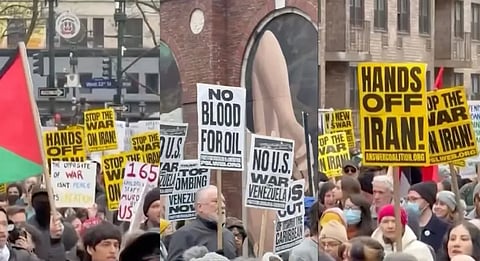
The multipolar shift amplifies previously marginalised voices in society. The tragedy in Gaza sparked global solidarity. Youth movements demand accountability from both old and new powers. Peace is not utopian but existential in this setting. Populations scarred by Ukraine’s trenches, Gaza’s rubble, the subcontinent’s near-miss and the Gulf’s MIRV exchanges crave stability. On every continent, opinion polls show that diplomacy is preferred to dominance.
The road ahead is fraught. Nuclear proliferation risks linger in South Asia after Iran's MIRV demonstration. Cyber and space domains remain ungoverned. The polycentric diffusion of power prevents any single crisis from paralysing the globe, but risks fragmentation into competitive blocs rather than collaborative ones. Yet the world's collective trauma has forged a consensus that did not exist before: peace through balance, not peace through dominance.
In the midst of the demise of American hegemony and the prolonged decline of corporate capitalism, a collective yearning for peace lies at the heart of everything. Yet what replaces it remains an enigma - a hybrid of socialism and capitalism, state-directed economies and market freedoms, democratic experiments and authoritarian efficiencies.
Unexpectedly, Pakistan is at the centre of this storm, attempting to establish rapport with Washington and Tehran since March 2026, as the reluctant host of the most important conversation since the Cold War.
The Islamabad talks, for all their farce and fury, proved a simple truth: dialogue is the only way forward. Not bombs. Not penalties. Just tired men and women in badly lit rooms, arguing over commas in ceasefire drafts, while outside the jasmine blooms and the jets circle overhead. It won't be angelic tranquility. But it is peace of a kind - serene enough to live in, fragile enough to remind us of what we stand to lose.
Have you liked the news article?