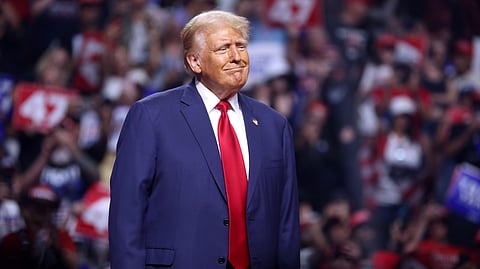


The sweeping Democratic victory in the United States midterm elections has delivered a major political setback to President Donald Trump, with consequences extending far beyond Washington to New Delhi, Tehran, Tel Aviv and the occupied Palestinian territories.
Democrats have won control of the Senate and are projected to regain the House of Representatives, ending Republican dominance of Congress and placing substantial restrictions on Trump's political agenda during the remaining two years of his presidency.
The results, which include unexpected Democratic victories in traditionally Republican states such as Texas, Kansas and South Carolina, reflect widespread frustration over inflation, tariffs, the war against Iran and the President's conduct in office.
According to Reuters, nearly nine in ten voters considered the cost of living an important factor in their electoral decisions. The agency also reported that about 70 percent wanted Congress to exercise stronger checks on presidential power.
But the election's significance extends beyond America's domestic political divisions. For countries that have built their diplomatic calculations around Trump's personal leadership, the return of a Democratic Congress introduces new uncertainties.
India, which has cultivated close relations with successive American administrations, faces questions about trade, immigration, Russian energy purchases and the future of its strategic partnership with Washington.
Iran could find a more receptive audience in Congress for demands to limit American military intervention, although the president retains considerable authority over foreign policy.
Israel, meanwhile, faces the prospect of greater scrutiny over American military assistance and its operations in Gaza, even as powerful pro-Israel lobbying organizations continue to enjoy influence across party lines.
For Palestinians, the election offers the possibility of renewed congressional debate over military aid and accountability, but no guarantee of a fundamental change in American policy.
India Faces Changed Washington
For Prime Minister Narendra Modi's government, the Democratic resurgence comes at a particularly sensitive moment.
New Delhi had invested considerable diplomatic energy in cultivating Trump, whose personal relationship with Modi was once portrayed as a major asset for India-US relations.
The relationship, however, has been strained by Trump's tariff policies, disputes over trade and disagreements concerning India's economic relations with Russia.
Al Jazeera reported shortly before the elections that Indian policymakers and analysts had grown increasingly frustrated with Trump's unpredictable approach, despite the earlier political warmth between the two leaders.
The Democratic victory could create additional opportunities for India to engage with congressional leaders who have traditionally supported closer bilateral relations.
However, it would be premature to assume that a Democratic Congress will automatically reverse Trump's tariff policies or adopt a more accommodating position towards New Delhi.
American concerns over India's trade surplus, market access and industrial policies are not confined to the Republican Party.
India's pharmaceutical, information technology, textile and manufacturing sectors will continue to face uncertainty as Washington debates tariffs, immigration and economic competition.
The Indian Express reported that Democratic control could increase scrutiny of the administration's trade and immigration policies without automatically reversing them.
For India's technology industry, the future of H-1B visas remains particularly important. Restrictions on skilled immigration affect Indian professionals, American technology companies and families with longstanding economic ties across the two countries.
A Democratic Congress could question the administration's immigration policies and demand greater transparency, but many visa rules remain subject to executive authority.
India's relationship with Russia presents another complication.
New Delhi has continued to defend its strategic autonomy and longstanding defence and energy ties with Moscow. Democratic lawmakers, however, have often advocated strong sanctions enforcement against Russia.
The resulting pressure could complicate India's efforts to balance its Russian connections with its expanding security partnership with the United States.
During previous Democratic control of the House, congressional hearings and statements raised questions about civil liberties, political detentions and restrictions imposed by Modi government.
The re-emergence of Democratic committee leadership could provide opportunities for renewed examination of human rights issues in South Asia.
The more realistic possibility is increased scrutiny through congressional hearings, reports and questions to administration officials, particularly if lawmakers choose to examine religious freedom, minority rights and democratic institutions in India.
Iran War Becomes Electoral Liability
The war against Iran appears to have played a more direct role in the election than many traditional foreign-policy disputes.
Trump entered his second presidency promising to put American interests first and avoid prolonged military entanglements. Yet the conflict with Iran, rising energy prices and its wider economic consequences became important sources of voter dissatisfaction.
The Council on Foreign Relations observed before the elections that the Iran war had become closely connected to American concerns about petrol prices and affordability.
Trump himself acknowledged the political consequences after the vote.
“I think a part of it was Iran,” he told Fox News, while defending the military campaign.
He also warned that he would veto Democratic legislation he considered unacceptable, suggesting that congressional opposition would not automatically produce a change in his foreign policy.
For Tehran, the Democratic takeover offers an opportunity to press for stronger congressional scrutiny of the administration's military decisions.
Democratic lawmakers could demand explanations about the objectives, financial costs and legal justification of American operations against Iran.
They could also seek to restrict funding or invoke congressional war powers to limit further military action.
However, the American President retains extensive authority over military deployments, sanctions and diplomacy.
Moreover, Democrats are not united in their approach towards Iran. Many remain critical of Tehran's nuclear programme, regional military activities and domestic human rights record.
Any reduction in tensions between Washington and Tehran could ease pressure on Indian energy security and improve the diplomatic environment for projects such as the Chabahar port, which New Delhi has supported as a route to Afghanistan and Central Asia.
Pakistan, too, has a direct stake in regional stability because of its border with Iran, energy requirements and concerns about the wider consequences of military escalation.
A prolonged conflict would affect oil-importing economies throughout South Asia, regardless of their political alignments.
Israel's Influence Faces Test
One of the more politically sensitive consequences of the elections concerns Israel and the influence of pro-Israel lobbying organizations in Washington.
The American Israel Public Affairs Committee, commonly known as AIPAC, has long played a significant role in congressional elections through campaign support and affiliated political organizations.
But the Gaza war has increasingly exposed divisions within the Democratic Party over American military assistance to Israel.
The Michigan Senate contest became a particularly prominent example.
Abdul El-Sayed, a physician and outspoken critic of Israeli military operations in Gaza, defeated Democratic Congresswoman Haley Stevens in the party's primary despite substantial spending by AIPAC-linked organizations supporting her.
The Associated Press reported that pro-Israel groups spent close to $30 million backing Stevens during the primary campaign.
The controversy continued into the general election, when Stevens endorsed Republican Mike Rogers rather than support her party's nominee.
The dispute illustrated how disagreements over Israel had begun to override traditional partisan loyalties.
AIPAC also faced criticism from within the broader pro-Israel political community.
Jeremy Ben-Ami, president of the liberal pro-Israel organization J Street, questioned AIPAC's decision to discontinue direct candidate endorsements while maintaining spending through its affiliated super PAC.
He argued that the change would do little to address concerns about the organization's political influence.
For Israel, the significance of the Democratic takeover is not that American support will disappear.
The US-Israel strategic relationship enjoys substantial backing in both major parties, and congressional majorities alone cannot fundamentally dismantle it.
The more immediate consequence may be greater scrutiny of weapons transfers, military spending and Israeli conduct in Gaza and the occupied West Bank.
The election also demonstrated that unconditional support for Israel has become a more contentious political position in sections of the American electorate.
Yet AIPAC and other pro-Israel organizations retain substantial financial resources and political networks, making any rapid transformation of Washington's Middle East policy unlikely.
Palestine Returns to Congressional Agenda
For Palestinians, the election raises expectations that American lawmakers may more aggressively question Washington's role in the Gaza war.
Progressive Democrats have increasingly demanded restrictions on offensive weapons transfers to Israel, investigations into civilian casualties and stronger American pressure to protect Palestinian rights.
During the election campaign, El-Sayed linked American military assistance to Israel with unmet domestic needs.
His argument was that American taxpayers should not finance overseas military operations while struggling with healthcare costs and deteriorating public infrastructure.
In Michigan, home to a substantial Arab American population, this message became part of a broader debate about the relationship between foreign policy and domestic priorities.
The divisions also extend to Jewish American voters. While some strongly opposed El-Sayed's positions, others supported greater restrictions on military assistance and a more critical approach to Israeli government policies.
Trump, meanwhile, announced on Election Day that the United States would stop providing approximately $4 billion in annual financial assistance to Israel by the end of 2026.
The announcement was particularly striking because the existing US-Israel military assistance agreement provides $3.8 billion annually through 2028.
Trump said Israel no longer required the same level of American financial support, although questions remain about the implementation of his proposal and the distinction between grants and weapons sales.
The announcement came amid growing electoral controversy over Israel, but it does not necessarily signal a withdrawal of American strategic support.
For Palestinians, the central question remains whether Washington will translate political debate into concrete changes in weapons supplies, diplomatic protection and accountability for violations of international law.
A Democratic Congress could provide additional forums for raising these questions. It could also increase pressure for humanitarian access, reconstruction and protection of Palestinian civilians.
But the Democratic Party remains divided, and significant policy changes would still face opposition from the White House and pro-Israel lawmakers.
Trump's Authority Weakened
The Democratic victory also changes the balance of power inside Washington.
In the House of Representatives, Democratic leader Hakeem Jeffries is positioned to become the first African American speaker, replacing Republican Mike Johnson.
Democratic control would allow congressional committees to investigate the administration, summon officials and demand documents concerning government decisions.
Senate control gives Democrats additional leverage over senior appointments, judicial confirmations and the administration's legislative priorities.
Reuters reported that the Democratic gains reflected widespread dissatisfaction with Trump's handling of the economy and concerns about government corruption.
Trump, however, has attempted to distance himself from the Republican defeat.
“I wasn’t on the Ballot and if I was, we would have won IN A LANDSLIDE!” he wrote on Truth Social.
The assertion contrasted with his campaign strategy, during which he repeatedly encouraged voters to treat Republican candidates as representatives of his presidency.
The president has also signaled that he intends to use his veto powers against Democratic legislation.
Consequently, the next two years could produce greater congressional oversight without necessarily delivering a corresponding transformation in American foreign policy.
What Results Mean for South Asia
For South Asian governments, the most important lesson from the election is that American foreign policy will now be shaped by a more complicated political environment.
India will need to maintain relations not only with the Trump administration but also with Democratic congressional leaders who may take different positions on tariffs, immigration, human rights, and relations with Russia.
The Democratic victory could also complicate the broader diplomatic calculations of governments that have relied heavily on Trump's personal assurances.
Unlike parliamentary systems, however, the American President does not lose office when his party loses control of the legislature.
Trump will remain President until January 2029 and retain substantial authority over diplomacy, sanctions, military operations and executive decisions.
Congress can constrain that authority, but it cannot automatically replace the administration's foreign-policy priorities.
The election, therefore, represents a shift in the balance of American political power rather than an immediate change of government.
For India, the results may offer some relief from Trump's unilateral political pressure, but they also introduce new complications concerning trade, Russia and human rights.
For Iran, they create opportunities for congressional scrutiny of military intervention without guaranteeing an end to confrontation.
For Israel, they bring renewed questions about American military assistance and the influence of pro-Israel lobbying organizations.
For Palestinians, they offer additional political space to challenge Washington's policies, though the path from congressional debate to meaningful change remains uncertain.
For the remainder of Trump's presidency, the central question will be whether the Democratic Congress can translate its electoral mandate into meaningful restraints on presidential power, particularly in matters of war, trade and international relations.
The answer will help determine the direction of American policy towards South Asia and the Middle East long after the immediate electoral celebrations have ended.
Have you liked the news article?
Support us now:
https://www.gofundme.com/manage/jammu-kashmirs-sole-independent-voice-under-threat