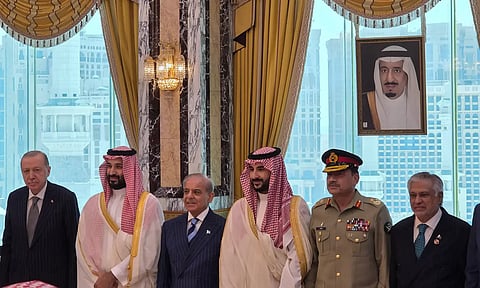


ANKARA: Türkiye, Saudi Arabia and Pakistan on Friday signed a landmark defence agreement in the holy city of Makkah, committing themselves to collective security under a pact that declares an armed attack against any one of the three countries will be regarded as an attack against them all.
The Makkah Joint Defence Agreement, signed by Turkish President Recep Tayyip Erdoğan, Saudi Crown Prince and Prime Minister Mohammed bin Salman, and Pakistani Prime Minister Shehbaz Sharif, represents one of the most significant security arrangements among Muslim-majority countries in recent decades.
While officials in all three capitals described the agreement as defensive in nature, its collective defence clause immediately drew international attention because of the strategic weight of the three signatories. Türkiye possesses NATO's second-largest standing military after the United States. Saudi Arabia remains the Arab world's biggest defence spender and custodian of Islam's holiest sites. Pakistan is the Muslim world's only declared nuclear weapons state with one of the region's largest armed forces.
The agreement was signed following high-level talks at Al-Safa Palace in Makkah, where the three leaders reviewed regional security developments, bilateral relations and expanding defence cooperation.
A joint declaration issued after the meeting said the agreement rests on the countries' "deep historical ties, longstanding brotherhood, Islamic solidarity, shared strategic interests and well-established defence cooperation."
The leaders said the pact reflects their common determination to strengthen collective deterrence, preserve peace and stability, expand military cooperation and build what they described as "a secure and prosperous future together."
The most consequential provision states that an armed attack against any one of the three countries shall be considered an attack against all of them.
Pakistan's Foreign Ministry later reaffirmed the clause, saying the agreement seeks to strengthen collective deterrence against aggression while deepening strategic defence cooperation among the three countries.
Although the declaration avoids identifying any potential adversary, the timing of the agreement leaves little doubt that it has been shaped by the rapidly deteriorating security environment across the Middle East.
The region has witnessed an unprecedented escalation in military tensions since the outbreak of the US-Iran war earlier this year. Missile exchanges, drone attacks, maritime disruptions in the Red Sea and Gulf waters, and repeated strikes on military and energy infrastructure have fundamentally altered regional security calculations.
Against this backdrop, the Makkah agreement represents the first formal attempt by three of the Muslim world's most influential military powers to institutionalise collective security beyond bilateral defence arrangements.
Ankara Seeks to Reassure Allies
Mindful that the announcement could be interpreted as the birth of a new military alliance, Turkish government sources moved quickly to explain the agreement's objectives.
According to senior Turkish officials, the Makkah Joint Defence Agreement "does not target any country" and should not be viewed as an aggressive military bloc.
Instead, they describe it as a defensive framework designed to strengthen regional peace through collective deterrence, burden-sharing and closer defence cooperation.
Officials said the agreement emerged after years of consultations conducted according to the principle of regional ownership, arguing that countries facing common security threats should increasingly develop their own mechanisms for cooperation rather than relying exclusively on external powers.
"The agreement is not an aggressive military bloc, an encirclement initiative or an instrument of offensive planning," Turkish government sources said.
"It is not directed against any state and does not close existing channels of dialogue with any country."
The sources insisted the pact's primary purpose is deterrence rather than confrontation.
According to Ankara, stronger defence cooperation among the three countries is intended to reduce the likelihood of conflict by increasing the cost of aggression against any member.
Turkish officials further stressed that the agreement is fully consistent with international law.
By recognising that an attack against one member would be treated as an attack against all, they argue the pact simply reinforces the inherent right of collective self-defence recognised under Article 51 of the United Nations Charter.
Officials also emphasised that the agreement remains entirely defensive.
Besides committing the three governments to support one another's security, it seeks to expand cooperation in defence industries, improve military interoperability and strengthen coordination among their armed forces.
Rather than replacing existing alliances, Ankara says the agreement complements them.
Not Alternative to NATO
Perhaps the most striking aspect of Türkiye's official explanation was its repeated emphasis that the Makkah Agreement should not be interpreted as an alternative to NATO.
Türkiye has been a NATO member since 1952 and continues to host some of the Alliance's most important military installations.
According to Turkish government sources, Ankara's NATO commitments remain unchanged.
"Türkiye's NATO membership and its regional partnerships are not alternatives to one another but complementary frameworks that facilitate security burden-sharing," officials said.
They added that Türkiye continues to fulfil all its obligations within NATO and maintains open consultation channels with its allies.
Similarly, Turkish officials rejected suggestions that the agreement seeks to replace the Gulf's existing security architecture.
Instead, they describe it as an additional layer of regional cooperation that contributes to stability without undermining existing partnerships.
That explanation reflects Ankara's broader foreign policy approach during the Erdoğan era, which has increasingly sought to balance Türkiye's Western alliances with a more assertive regional role stretching from the Mediterranean and the Black Sea to the Gulf, the Horn of Africa and Central Asia.
The Makkah Agreement therefore represents not a departure from Turkish strategic thinking but an extension of Ankara's effort to build overlapping security partnerships across multiple regions while retaining its NATO commitments.
Whether this balancing act satisfies both Western allies and regional partners will become clearer as the agreement begins to take institutional shape.
For now, however, Turkish officials insist that the pact should be viewed as "a supporting pillar of peace, stability and security" rather than the emergence of a rival military alliance.
Changing West Asia
Although the Makkah Joint Defence Agreement was negotiated over an extended period, diplomats say the pace of discussions accelerated dramatically after the strategic landscape of the Middle East changed over the past year.
The immediate backdrop is the regional conflict triggered by the US-Iran war, which exposed the vulnerability of critical infrastructure across the Gulf. Missile and drone attacks, maritime disruptions in the Red Sea and Gulf waters, cyber operations and long-range strikes demonstrated that future conflicts would no longer remain confined within national borders.
Saudi Arabia, despite spending tens of billions of dollars annually on defence, found that conventional military strength alone could not fully shield the Kingdom from increasingly sophisticated missile and drone attacks. The conflict also highlighted the need for better intelligence sharing, integrated air defence, joint planning and closer military coordination among friendly states.
For Türkiye, the changing environment reinforced a strategic doctrine that President Recep Tayyip Erdoğan's government has pursued for more than a decade: reducing dependence on external security guarantees while building stronger regional partnerships backed by indigenous defence production.
Pakistan viewed the changing security environment through a different lens. Islamabad has traditionally maintained close military relations with Saudi Arabia while expanding strategic cooperation with Türkiye over the past decade. The Makkah agreement effectively brings those two bilateral relationships under one institutional umbrella.
The three governments appear to have concluded that future threats would increasingly come from missiles, drones, cyber warfare, sabotage of critical infrastructure, maritime disruptions and attacks by non-state actors rather than only conventional interstate warfare.
The agreement therefore attempts to create a permanent framework for responding collectively to such evolving challenges.
More Than Military Alliance
Despite the attention generated by its collective defence clause, officials insist the agreement is much broader than a military treaty.
According to Turkish government sources, the framework envisages cooperation in defence planning, military education, training, joint exercises, intelligence coordination, defence technologies and industrial collaboration.
One of its central objectives is to improve military interoperability. In military terminology, interoperability means the ability of armed forces from different countries to operate together seamlessly during joint exercises, peacekeeping operations or military emergencies. This requires compatible communications systems, common operational procedures, integrated logistics and coordinated command structures.
Over the past decade, Türkiye and Pakistan have steadily expanded joint military exercises involving their air forces, naval units and special forces. Saudi Arabia has also increased defence cooperation with both countries, although largely on a bilateral basis.
The Makkah Agreement institutionalises these efforts by providing an overarching framework for closer military integration.
Turkish officials say defence industrial cooperation will become another major pillar of the agreement.
Türkiye today possesses one of the fastest-growing defence industries in the world, producing armed drones, naval platforms, armoured vehicles, precision-guided munitions, electronic warfare systems and advanced aerospace technologies. Saudi Arabia, under Vision 2030, has committed itself to localising a significant share of its defence procurement through domestic production and technology transfer.
Pakistan brings decades of operational military experience, an established defence manufacturing base and expertise in missile technology, aircraft production and strategic deterrence.
Analysts believe combining these complementary strengths could create new opportunities for joint research, co-production, technology transfer and defence exports.
Intelligence Cooperation
Although the declaration makes only passing reference to security cooperation, intelligence coordination is expected to become one of the agreement's most significant components.
Türkiye's National Intelligence Organization (MIT), Pakistan's Inter-Services Intelligence (ISI) and Saudi Arabia's General Intelligence Presidency have expanded cooperation over recent years in areas ranging from counterterrorism to regional security assessments.
The presence of MIT Director İbrahim Kalın at the Makkah meeting alongside Foreign Minister Hakan Fidan underscored the importance Ankara attaches to the intelligence dimension of the new partnership.
Closer intelligence sharing could enhance early warning capabilities against missile launches, drone attacks, cyber threats, terrorism financing and transnational militant networks.
Security analysts note that modern military partnerships increasingly depend as much on intelligence integration as on conventional troop deployments.
Almost immediately after the announcement, commentators began describing the Makkah Agreement as an "Islamic NATO." Turkish officials reject that characterisation.
The comparison stems largely from one provision: the commitment that an attack against one member will be regarded as an attack against all.
That language inevitably recalls Article 5 of the North Atlantic Treaty, under which NATO members agree that an armed attack against one ally is considered an attack against all.
There are, however, important differences.
NATO is a highly institutionalised alliance with an integrated military command structure, permanent headquarters in Brussels, standardised planning procedures, joint force commands, common operational doctrines and decades of established practice.
The Makkah Agreement contains none of those institutional features, at least in its present form.
Instead, it establishes a political and strategic framework through which the three governments intend to deepen cooperation.
Unlike NATO, it does not create a standing multinational military headquarters, unified command structure or permanent integrated forces.
Nor does it include explicit provisions regarding overseas deployments or automatic military intervention.
Turkish officials therefore argue that the comparison with NATO should not be overstated.
"The agreement complements existing alliances," government sources said. "It does not replace them."
Officials also emphasise another distinction.
NATO emerged during the Cold War as a collective defence alliance against a clearly identified strategic rival.
The Makkah Agreement deliberately avoids identifying any adversary.
Its language repeatedly stresses peace, stability, deterrence and dialogue while avoiding references to confrontation or bloc politics.
Why These Countries?
The composition of the new partnership reflects strategic logic rather than geography alone.
Türkiye contributes advanced military technology, operational experience across multiple theatres, a rapidly expanding defence industry and NATO expertise.
Saudi Arabia contributes financial resources, regional political influence and a central position within the Arab and Islamic worlds.
Pakistan contributes military manpower, extensive operational experience and, most significantly, strategic nuclear deterrence.
Each country also occupies a different geopolitical space.
Türkiye links Europe, the Black Sea, the Eastern Mediterranean and West Asia.
Saudi Arabia occupies the heart of the Arabian Peninsula and sits astride global energy routes.
Pakistan connects the Middle East with South Asia and the western approaches to the Indian Ocean.
Together, the three countries span a vast strategic arc stretching from the Mediterranean to the Arabian Sea.
For Ankara, this geographic reach fits neatly into Erdoğan's broader vision of positioning Türkiye as a pivotal power linking Europe, Asia and the Middle East.
For Riyadh, the agreement broadens security partnerships beyond its long-standing dependence on Western defence relationships.
For Islamabad, it institutionalises ties with two of its closest strategic partners while enhancing its diplomatic relevance in an increasingly turbulent region.
Whether these ambitions translate into an enduring security architecture will depend less on the language of the declaration than on how quickly the three governments move to establish the institutions, mechanisms and military cooperation that give substance to such agreements.
Implications for Region and Beyond
The significance of the Makkah Joint Defence Agreement extends well beyond the three signatories. Its impact will be closely watched in Tehran, Washington, Brussels, Tel Aviv, New Delhi and Beijing, each of which has strategic interests in the Middle East.
Although the agreement avoids identifying any adversary, its timing ensures that it will inevitably be viewed through the prism of the region's evolving security competition.
Turkish officials have repeatedly emphasised that the pact is "not directed against any country" and is intended to reinforce peace through deterrence rather than confrontation. Nevertheless, defence analysts note that collective defence arrangements are often shaped as much by the strategic environment as by their formal language.
The agreement therefore represents an acknowledgement that the security landscape of the Middle East has entered a new phase, one in which regional powers increasingly feel the need to develop indigenous security mechanisms alongside their traditional partnerships with external powers.
For Iran, the agreement presents both a diplomatic and military challenge.
On the one hand, Tehran is likely to view closer defence coordination among Saudi Arabia, Türkiye and Pakistan with caution, particularly because it brings together three countries that collectively possess significant military capabilities, growing defence industries and considerable political influence in the Islamic world.
The collective defence clause may also raise concerns in Tehran that any future regional conflict involving one of the three members could potentially draw the others into a coordinated response.
On the other hand, Turkish officials have gone to unusual lengths to reassure regional actors that the agreement is neither an anti-Iran coalition nor a new containment strategy.
That distinction reflects Ankara's own complicated relationship with Tehran.
Despite competing for influence in Syria, Iraq and the South Caucasus, Türkiye and Iran maintain substantial trade, energy cooperation and regular diplomatic engagement. Both governments have generally sought to compartmentalise areas of disagreement while preserving broader bilateral relations.
Saudi Arabia's relationship with Iran has also undergone important changes since the Chinese-brokered rapprochement of 2023, even though subsequent regional crises have tested that détente.
Pakistan likewise has little interest in becoming part of a military confrontation with its western neighbour, with whom it shares a nearly 900-kilometre border.
These factors explain why the agreement deliberately avoids language that could be interpreted as targeting Tehran.
Israel is also likely to study the agreement carefully.
Over the past several years, Türkiye has become increasingly critical of Israeli policies in Gaza and the occupied Palestinian territories, while Saudi Arabia has suspended discussions on normalisation following the Gaza war.
The emergence of a formal security arrangement among three influential Muslim-majority states will inevitably attract attention in Israeli strategic circles, even if the agreement itself contains no reference to Israel.
For Washington, however, the picture is more nuanced.
Türkiye remains a NATO ally and hosts important Alliance facilities.
Saudi Arabia continues to maintain extensive defence cooperation with the United States despite periodic political differences.
Pakistan, although no longer enjoying the close strategic relationship it once had with Washington, continues military-to-military contacts with the United States.
Rather than challenging American security interests directly, the Makkah Agreement appears to reflect a broader trend in which regional powers seek greater strategic autonomy while continuing cooperation with global partners.
That interpretation is consistent with Turkish officials' repeated assertion that the agreement complements rather than replaces existing alliances.
India's Perspective
The agreement is also likely to be followed closely in New Delhi.
India enjoys deep strategic relations with all three signatories, although the nature of those relationships differs significantly.
India has developed strong political, economic and defence partnerships with Saudi Arabia and has steadily expanded strategic cooperation with Gulf countries over the past decade.
From New Delhi's perspective, the agreement is unlikely to alter the regional military balance immediately because it creates a framework for cooperation rather than a fully integrated alliance.
Nevertheless, Indian strategic planners will closely monitor future developments, particularly if the agreement results in expanded joint military exercises, intelligence sharing, defence technology collaboration or coordinated security policies.
Indian analysts are also likely to assess whether deeper defence cooperation between Türkiye and Pakistan could accelerate transfers of military technology or increase defence industrial collaboration.
One of the more intriguing aspects of the Turkish explanation is its indication that the framework is not intended to remain permanently limited to three members.
Government sources described the agreement as a cooperative framework that remains open to other countries in the region.
No accession mechanism has yet been announced, nor have the three governments publicly identified potential future participants.
Nevertheless, the statement has fuelled speculation that the agreement could eventually evolve into a broader regional security arrangement if political conditions permit.
Several Muslim-majority countries already maintain defence cooperation with one or more of the three signatories through bilateral agreements, joint military exercises or defence industrial partnerships.
Whether those relationships eventually become institutionalised under the Makkah framework remains uncertain.
Much will depend on future regional politics, relations among Gulf states, and the willingness of potential partners to participate in a collective defence arrangement.
Opportunities and Challenges
Transforming a political declaration into an effective security institution is rarely straightforward.
The history of regional defence arrangements demonstrates that formal agreements alone do not automatically produce military integration.
Establishing common operational procedures, harmonising procurement policies, integrating communications systems, conducting regular joint exercises and developing shared strategic planning mechanisms require sustained political commitment over many years.
The three countries also possess different strategic priorities.
Türkiye's principal security concerns extend from the Black Sea and Eastern Mediterranean to Syria and the Caucasus.
Saudi Arabia's focus remains the Arabian Peninsula, maritime security, energy infrastructure and the Gulf.
Pakistan's security priorities continue to centre on South Asia, Afghanistan and counterterrorism.
Reconciling these different strategic outlooks while maintaining an effective collective defence framework will require careful diplomacy and institutional development.
Yet the agreement also offers important opportunities.
Joint defence production could reduce dependence on external suppliers.
Greater intelligence cooperation could strengthen responses to terrorism, cyber threats and transnational organised crime.
Enhanced military interoperability could improve humanitarian assistance, disaster relief operations, maritime security and peacekeeping missions in addition to conventional defence.
The Makkah Joint Defence Agreement reflects a broader transformation taking place across international politics.
For decades, security in the Middle East was largely organised around external powers, particularly the United States.
Increasingly, however, regional states are seeking to assume greater responsibility for their own security while diversifying strategic partnerships.
Türkiye has pursued that approach through a combination of indigenous defence production, diplomatic activism and regional engagement.
Saudi Arabia's Vision 2030 similarly seeks greater strategic and technological self-reliance.
Pakistan has expanded defence cooperation with both countries while maintaining longstanding relationships with China, the Gulf states and other international partners.
Whether the Makkah Agreement ultimately becomes a defining feature of the region's future security architecture will depend less on the declaration signed in Makkah than on the institutions the three governments build in the years ahead.
For now, the agreement should be viewed less as the creation of an "Islamic NATO" than as the formalisation of an evolving strategic partnership among three influential Muslim-majority states seeking to adapt to an increasingly uncertain regional environment.
Its immediate significance lies not in creating a new military bloc but in signalling that major regional powers are prepared to assume greater collective responsibility for their own security while continuing to work within existing international alliances.
If implemented as envisaged, the Makkah Joint Defence Agreement could become one of the most consequential regional security initiatives to emerge from the Muslim world since the establishment of the Gulf Cooperation Council more than four decades ago. Whether it achieves that ambition will depend on political will, institutional follow-through and the ability of its members to translate broad strategic intent into practical military cooperation.
Have you liked the news article?
Support us now:
https://www.gofundme.com/manage/jammu-kashmirs-sole-independent-voice-under-threat