

The unipolar moment, long declared over in theory, met its unequivocal end in the sands of Libya, when Saif al-Islam Gaddafi was assassinated on February 3, 2026, in Zintan by four masked gunmen who stormed his home, disabled cameras, and shot him (along with others). Widely believed to have been carried out by external powers looking to settle old scores, his killing sparked not only a desert but also the collective conscience of a continent.
In Bani Walid, that sea of mourners devastated by the nation’s ‘stolen sovereignty’ spoke louder than any bomb. Libya's unhealed wounds are the verdict of history. Unlike 2011, the Africa of 2026 did not respond with scattered confusion but rather with a unified, institutional rebuke in the form of the Lagos Declaration, which condemned ongoing external manipulation.
The African new paradigm is not defined by a binary US-China direct contest, but by a crowded, competitive field where middle powers like Russia, Turkey, the Gulf states, like Saudi Arabia, besides India, Pakistan and other regional anchors like South Africa, Nigeria, and Egypt, are decisive players.
Egypt pursues a dual role; mediating ceasefire talks and advocating for a Palestinian state, rather than a two-state solution, while leading plans for Gaza's post-war reconstruction. It balances this with maintaining its historic peace treaty with Israel, crucial for regional stability.
The US remains a key partner for many African states, but its influence has slipped from unquestioned dominance to something more contested. Its moral authority is eroded by its forever wars and unilateral interventions, now met with growing institutional resistance. Africa, for its part, is playing its 54 sovereign cards deliberately, aligning with interests rather than blocs.
US-Africa ties have evolved beyond Cold War geopolitics toward trade, security, and governance.
China has established a deep, multi-decade engagement centered on massive infrastructure investment, trade, and a doctrine of non-interference, creating a complex alternative to Western models.
Since 2022, Russia has aggressively re-entered the picture, offering arms and political cover to military regimes with few strings attached, primarily to chip away at Western influence.
Collectively, this dynamic presents African states with a broader, more competitive array of external partners, each offering distinct models of engagement - strategic, economic, and securitized - amid ongoing debates about sovereignty, debt, and mutual benefit.
Iran and Libya are quietly rebuilding ties, with high-level meetings in late 2025 focused on security and cooperation. After a complicated relationship during the Gaddafi era, both countries are now cautiously pursuing shared interests in stability, sovereignty, and economic opportunity.
The African Anchors
African agency is not abstract. Rather, it is driven by potent continental engines that turn emotion into action.
South Africa is the legal vanguard. Pretoria punches above its economic weight as Africa's moral and legal engine. Its International Court of Justice (ICJ) case against Israel exemplifies a foreign policy built on universal rule-of-law principles rooted in its anti-apartheid legacy.
Working in close alignment with Egypt and Nigeria within the African Union (AU), it converts African grievances into coordinated diplomatic positions. Its role in the January 2026 China-AU Strategic Dialogue, where Beijing explicitly endorsed African stances on Palestine and UNSC reform, shows its skill at grafting continental priorities onto major-power agendas.
Nigeria is the pragmatic giant. Lagos and Abuja run a transactional "Nigeria First" policy, maintaining deep ties with Western partners while buying Turkish attack helicopters, Chinese drones, and expanding tech and pharma links with India. Domestic security and economic development drive partner selection. Yet on continental diplomacy, Nigeria works in close lockstep with South Africa, quietly anchoring many pan-African positions.
Egypt is the crossroads heavyweight. Cairo leverages its unique position as the Arab world anchor, African player, long-standing US military partner, and Gulf investment destination to protect two core interests: Nile water security and regional stability. Its relationship with Ethiopia is therefore paramount.
Egypt has now escalated its Sudan involvement, deploying advanced Turkish Bayraktar Akinci combat drones near the border in support of the Sudanese Armed Forces against the Rapid Support Forces (RSF), which marks a notable shift from prior restraint, coinciding with a new Turkish-Egyptian defense framework signed during Erdogan's recent visit.
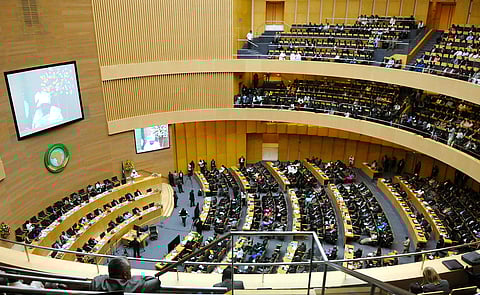
The AU remains the arena where these dynamics converge - bureaucratically strained but capable of coordinated action, as the Lagos Declaration showed. The African Continental Free Trade Area (AfCFTA) project underpins it all, working to transform the continent into a unified market and give sovereignty an economic backbone.
Complementing these developments is Saudi Arabia's strategic pivot. Riyadh is rapidly reorienting its Africa posture. From a relationship historically centered on religion to one driven by investment and geopolitics. At the core of Crown Prince Mohammed bin Salman's Vision 2030, the pivot aims to expand Gulf influence, secure food and mineral supply chains, and diversify the Saudi economy across the continent.
Multipolarity Amid Complex Realities
The Democratic Republic of Congo (DRC) exemplifies pure pragmatism of partnering with Western mining firms, UN missions, Chinese military advisors, and infrastructure consortia simultaneously, while maintaining defense ties with both India and Pakistan.
Somalia is multipolarity's most competitive arena. The AU, EU, and US anchor security, while Turkey runs its largest foreign military base there, the UAE and Saudi Arabia vie for influence, China eyes port deals, Pakistan trains troops and is set to deliver JF-17 fighters, and India builds development capacity. Mogadishu plays all sides deliberately.
Ethiopia, a new BRICS member, re-emerges from conflict with a clear multipolar strategy, leveraging China for infrastructure, the UAE for economic support, and BRICS payment systems for financial diversification, while fiercely guarding Nile basin dominance.
Rwanda runs a disciplined, interest-based foreign policy, generating revenue and credibility through peacekeeping while maintaining strong ties with the US, UK, Qatar, and Singapore. Its DRC entanglement shows multipolarity can fuel regional assertiveness.
Across the continent, the pattern is consistent. African states are choosing partners rather than sides. Ghana remains a stable Western-aligned democracy while quietly diversifying investment sources. Uganda and Zimbabwe lean toward China and Russia despite Western friction. Tanzania cautiously balances Chinese infrastructure funding against traditional Western development partnerships, while Senegal and Côte d'Ivoire pursue a gradual, deliberate drift from post-colonial French orbit toward broader engagement.
There are no permanent allegiances and increasing confidence in playing competing powers against one another.
South Asian Nuance
Asia's engagement with Africa extends well beyond China.
India's engagement is multi-layered and quietly ambitious. It blends development finance, digital infrastructure exports like India Stack, generic pharmaceuticals, and cultural soft power into a coherent alternative to both Western conditionality and Chinese scale. Its significant UN peacekeeping contributions and active AU participation let it counterbalance Chinese influence without direct confrontation.
Pakistan operates on a narrower track, contributing meaningfully through military training programs and peacekeeping across Nigeria, Kenya, and beyond, with security cooperation and religious-cultural ties as its primary currency. Its domestic instability limits strategic reach, but it remains a valued niche partner in defense circles.
Together, they illustrate a broader African trend, that of selectively engaging partners for specific, non-hegemonic benefits, further eroding the leverage of traditional powers.
The New Architecture in 2026
Three developments in early 2026 signal a structural shift in how Africa engages the world.
The China-AU Strategic Dialogue in mid-January produced a joint statement endorsing African positions on Palestine and UNSC reform, which is a diplomatic milestone reflecting years of South African and AU groundwork, marking a move from purely bilateral China-Africa ties toward a more institutionally aligned partnership.
The Lagos Declaration emerged as a continent-wide denunciation of unilateral external intervention, a direct response to the Libya killings, transforming African institutional resistance from sentiment into enforceable political posture.
Meanwhile, Egypt and Ethiopia's integration into BRICS+ accelerated momentum around the BRICS Payment System, with pilots for oil and gas transactions offering a tangible alternative to dollar dominance. However, India's cautious participation reveals the underlying tension: reducing Western financial hegemony without simply substituting Chinese.
The Uncontested Paradigm
The race to get to Africa is over. The new scramble is for allegiance. Furthermore, Africa will no longer serve as the arbitrator in 2026. The United States of America's drifting influence is a key feature of this landscape. It is not absent, but it is accepted as one of many poles, its actions are scrutinised, and its legacy, like Libya’s, is a liability as much as it is an asset. The killing of Gaddafi's son did not catalyse a new American intervention, but a unified African recoil and institutional response.
Structured hedging is the continent's strategy. However, 2026's multipolarity is not neat.
Swaps of minerals for infrastructure, competing port deals, overlapping military training missions, and intricate voting blocs make up this world. It carries risks of debt, over-dependence, and regional conflicts fueled by rival proxies. But it also carries the profound promise of agency. African nations are now subjects, not objects, of international relations.
Though messy and uneven, for the first time in centuries, Africa is asserting with a newfound confidence. The rules of engagement are being written, in part, in Addis Ababa, Abuja, and Pretoria.
Have you liked the news article?
Support us now:
https://www.gofundme.com/manage/jammu-kashmirs-sole-independent-voice-under-threat